 Hack the Route Start learning Open app
Encryption and certificates
Encoding and decoding
Rewriting bytes as safe text by a public, keyless recipe — so it always decodes straight back and protects nothing.
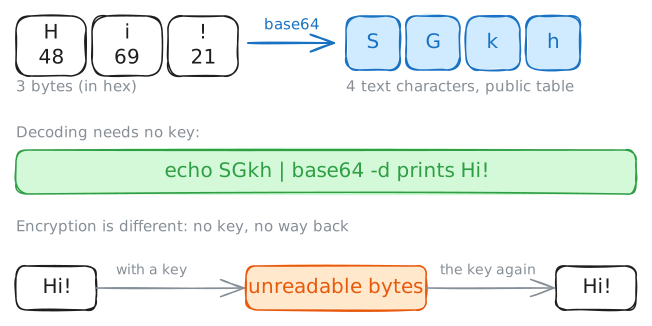
Encoding rewrites bytes as safe text by a public recipe with no key, so anyone reverses it. Base64 turns every three
bytes into four characters from A-Z a-z 0-9 + /, padded with =; hex writes each byte as two digits; URL-encoding
writes unsafe characters as % and two hex digits. base64 -d gives the exact bytes back. Unlike encryption it hides
nothing: Authorization: Basic carries the password in base64.