 Hack the Route Start learning Open app
Digital forensics
File-system timeline
Ordering a case by the times a file system keeps on every file, to read what happened minute by minute.
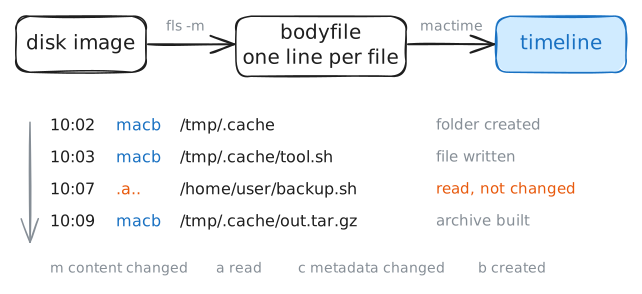
A file-system timeline is one list of every file's times, sorted, so a case reads as a sequence of events. Each
file has four: content changed (mtime), read (atime), metadata changed (ctime) and, on ext4 and NTFS,
created (crtime). fls -m writes them as a bodyfile; mactime sorts it. A file only read shows a new atime
alone. The times are only as honest as the clock that set them.
Read next
- Disk and memory forensics Reading a seized disk image or memory capture for what happened, without changing the evidence.
- Indicators of compromise (IOC) Concrete artifacts of an attack — an address, a file path, a hash — that you block and hunt for everywhere.
- Incident response phases The ordered runbook for handling a compromise: prepare, identify, contain, eradicate, recover, learn.