 Hack the Route Start learning Open app
Digital forensics
Disk and memory forensics
Reading a seized disk image or memory capture for what happened, without changing the evidence.
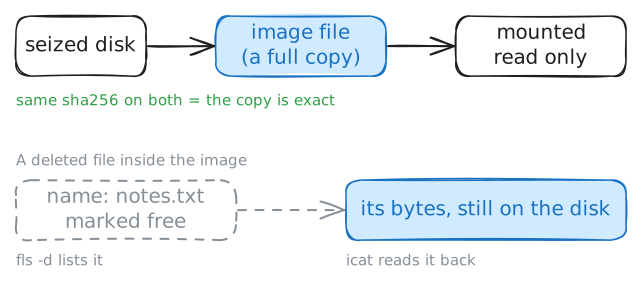
Disk and memory forensics reads a seized disk or memory capture without changing the evidence. Work on a copy, a
disk image, checked by its hash and mounted read only. Deleting a file removes its name, not its bytes: fls -d
lists it and icat reads it back until it is overwritten. Carving (foremost) finds files by their first and
last bytes. Memory holds what never reaches disk: keys, tokens.
Read next
- Indicators of compromise (IOC) Concrete artifacts of an attack — an address, a file path, a hash — that you block and hunt for everywhere.
- Incident response phases The ordered runbook for handling a compromise: prepare, identify, contain, eradicate, recover, learn.
- File integrity monitoring Recording a fingerprint of trusted files while a host is known-good, then checking later which ones have changed.
- File-system timeline Ordering a case by the times a file system keeps on every file, to read what happened minute by minute.
- Binary reverse engineering Working out what a program does when you have only the compiled binary, by reading it and by running it.