 Hack the Route Start learning Open app
Network attacks
Lateral movement
Moving from a host you already own onto another host inside the network — usually with reused or stolen valid credentials, not a fresh exploit.
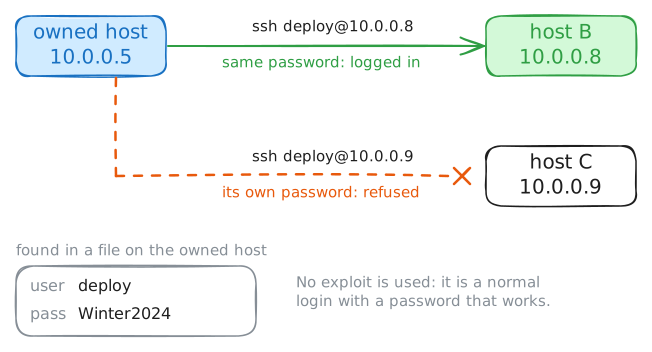
Lateral movement is going from one host you control to another inside the network. It rarely needs an exploit: a password, key or token found on the first host is reused on the next, over a normal service such as SSH, SMB or RDP. A valid login leaves little to detect. Unique credentials per host stop it; one account signing in to many hosts in a short time reveals it.
Read next
- Pivoting Using a host you already control as a relay to reach a network that has no route from where you stand — the compromised box bridges the two segments.
- Network discovery Mapping what a foothold can reach before acting on it — which segments, which hosts, which one box bridges to a network you cannot touch directly.
- SOCKS proxy A circuit-level gateway: it opens any TCP connection a client asks for and relays the bytes unread.
- Data exfiltration Reaching and taking the target data — and that the softest copy of it, like a backup replica, is often an easier route to the crown jewels than the guarded original.