 Hack the Route Start learning Open app
Network attacks
Network discovery
Mapping what a foothold can reach before acting on it — which segments, which hosts, which one box bridges to a network you cannot touch directly.
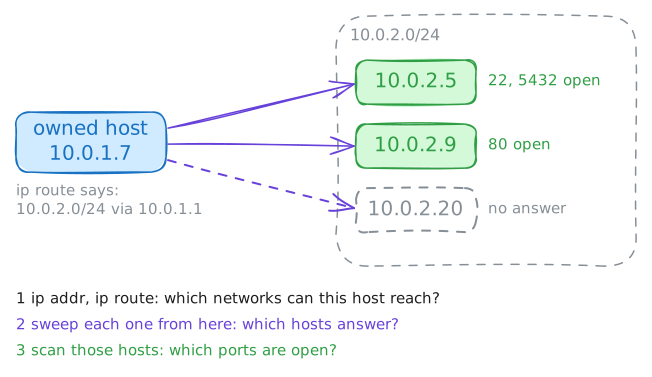
Network discovery is mapping what a host you control can reach. Read its interfaces and routes (ip addr, ip route get <target>), then sweep each reachable network from that host for hosts that answer and their open ports ([[port-scanning|port scanning]]). The result is a map: the target, its network and the path to it. A firewall that trusts a host by source address gives that reach to whoever controls it.
Read next
- Pivoting Using a host you already control as a relay to reach a network that has no route from where you stand — the compromised box bridges the two segments.
- Port scanning Probing an address's ports to learn which services it exposes, and whether a firewall sits in the way.
- SOCKS proxy A circuit-level gateway: it opens any TCP connection a client asks for and relays the bytes unread.
- Lateral movement Moving from a host you already own onto another host inside the network — usually with reused or stolen valid credentials, not a fresh exploit.
- Data exfiltration Reaching and taking the target data — and that the softest copy of it, like a backup replica, is often an easier route to the crown jewels than the guarded original.