 Hack the Route Start learning Open app
Network attacks
Session hijacking
Stealing a live session's identifier — a cookie read off the wire — and presenting it to the server to act as that user, without ever knowing their password.
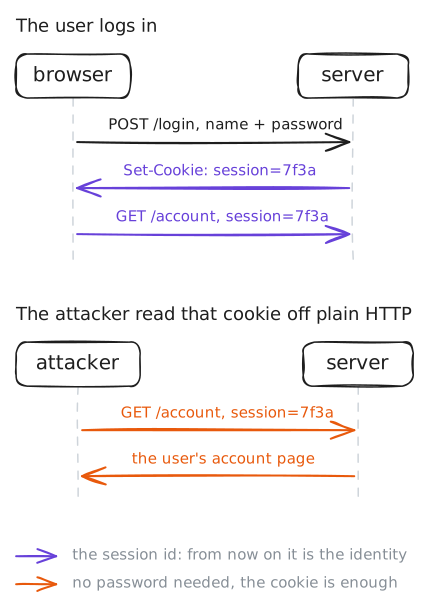
Session hijacking steals the session identifier a server put in a cookie at login and sends it back as the victim. Until the session ends the cookie is the identity, so no password is needed. On plain HTTP an attacker in a [[man-in-the-middle]] position, often by [[arp-spoofing|ARP spoofing]], reads it. The fix: [[tls|TLS]] everywhere with HSTS, the Secure and HttpOnly cookie flags, and a new id at each privilege change.
Read next
- Man in the middle A machine placed on the path between two parties, able to read and alter what is not protected end to end.
- ARP spoofing Forged ARP messages that tie someone else's IP address, usually the gateway's, to the attacker's MAC address.
- TLS and certificates Encryption plus proof of identity: the server shows a certificate for the name, signed by a trusted authority.
- Replay attack Resending a captured, still-valid request so the server honours it a second time — because nothing in the message ties it to a single use.