 Hack the Route Start learning Open app
Digital forensics
Binary reverse engineering
Working out what a program does when you have only the compiled binary, by reading it and by running it.
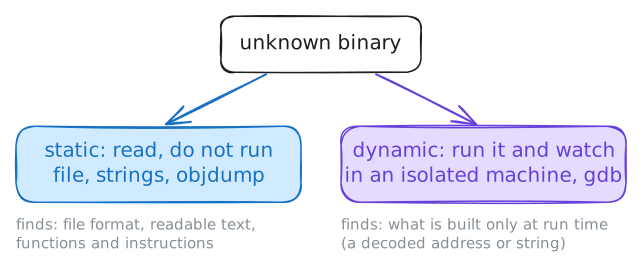
Binary reverse engineering works out what a program does from the compiled file alone. Static analysis reads
it without running it: file names the format, strings pulls readable text, a disassembler (objdump, radare2)
shows the instructions. It misses whatever the program builds only at run time, such as a decoded address. Dynamic
analysis runs the sample in an isolated machine and reads that value from memory in a debugger (gdb).
Read next
- Disk and memory forensics Reading a seized disk image or memory capture for what happened, without changing the evidence.
- Indicators of compromise (IOC) Concrete artifacts of an attack — an address, a file path, a hash — that you block and hunt for everywhere.
- Persistence Whatever an implant installs so it survives a reboot or a kill, like a cron entry that relaunches it.