 Hack the Route Start learning Open app
Incident response
Diamond Model of intrusion analysis
A four-cornered model of one intrusion event — adversary, capability, infrastructure, victim — whose edges let an analyst pivot from one known fact to the next.
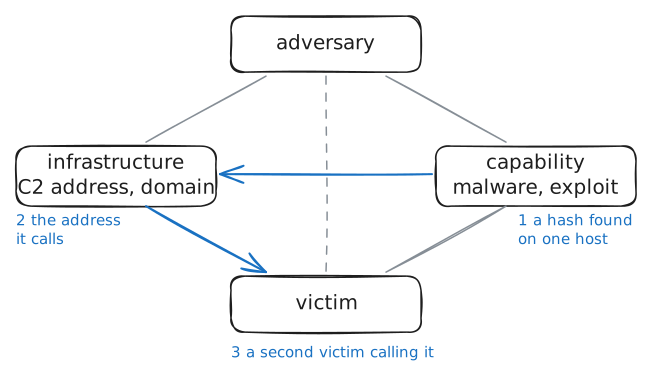
The Diamond Model (Caltagirone, Pendergast and Betz, 2013) describes one malicious event by four features: the adversary, the capability (malware, an exploit), the infrastructure (a C2 address or domain) and the victim. Each edge is a pivot: an implant's hash leads to the address it calls, then to a second victim. The [[kill-chain]] orders when a step falls; the diamond maps what connects to what. Naming the adversary is rarely needed.
Read next
- Kill chain and MITRE ATT&CK Models that break an intrusion into ordered stages, giving defenders shared language for what happened.
- Indicators of compromise (IOC) Concrete artifacts of an attack — an address, a file path, a hash — that you block and hunt for everywhere.
- Incident response phases The ordered runbook for handling a compromise: prepare, identify, contain, eradicate, recover, learn.
- Threat actor Whoever is behind an attack, sorted by kind: inside or outside, what they want (motivation), and the skill, time and money they bring (capability).