 Hack the Route Start learning Open app
Security foundations
Threat actor
Whoever is behind an attack, sorted by kind: inside or outside, what they want (motivation), and the skill, time and money they bring (capability).
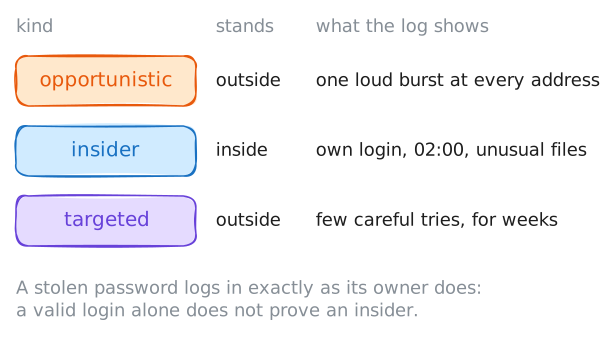
A threat actor is the person or group behind an attack. Three questions sort one: inside the organisation or outside it, motivation (money, espionage, disruption, revenge, a belief) and capability (skill, time, funding). An opportunistic actor sweeps every address with ready-made tools; a targeted one studies a chosen victim and returns for weeks; an insider uses a login it was given. A valid login does not prove an insider: a stolen password works the same. Naming the real person is attribution ([[diamond-model]]).
Read next
- Diamond Model of intrusion analysis A four-cornered model of one intrusion event — adversary, capability, infrastructure, victim — whose edges let an analyst pivot from one known fact to the next.
- True and false positives An alert's worth is how often it is a real attack versus noise, which decides whether anyone acts on it.
- CIA triad The three promises a system makes about its data and service: confidentiality, integrity and availability.
- Vulnerability classes Vulnerabilities sorted by kind, because the kind decides the fix: patch, change, reconfigure, validate, or rotate and remove.
- Security control types Controls sorted by the job each does (prevent, deter, detect, correct, direct, compensate) and by who or what carries each out.