 Hack the Route Start learning Open app
The idea
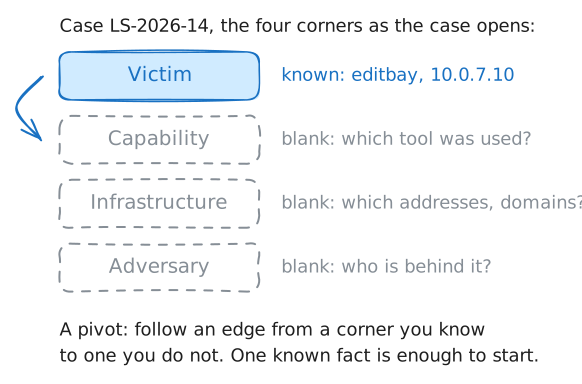
Soraya does threat analysis at Larkspur Studio, a small design agency. One workstation, editbay, was caught making an odd outbound connection, and the clean-up is done. Her job now is not to re-fight that one host but to lay the intrusion out on the Diamond Model and pivot: use each fact she has to find the one she is missing, until a single alert turns into the shape of the whole campaign.
Steps
-
Four corners of one event
The Diamond Model draws any intrusion event as four corners joined by edges: Adversary (who is behind it), Capability (their tools and methods), Infrastructure (the addresses and domains they use), and Victim (who was hit). Every event has all four, even when you only know one of them.
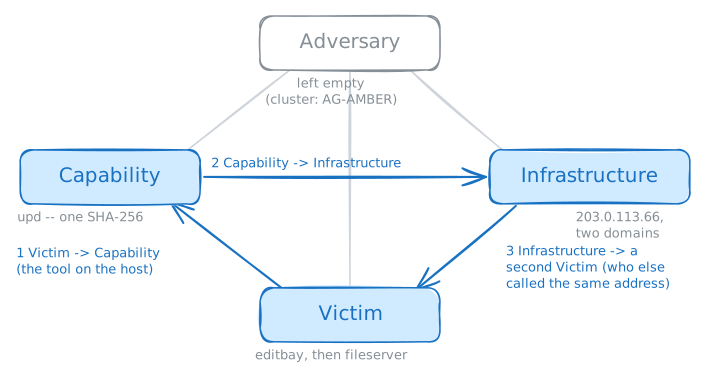
The power of the model is the edges. Knowing one corner lets you reach another: a tool points at the infrastructure it talks to, an address points at everyone who talked to it. Following an edge from a known corner to an unknown one is called a pivot, and it is how one event grows into a campaign.
This is analysis, not a live hunt. The evidence is already captured; the work is to fill corners and follow edges, with no scanning or probing of anything outside the lab.
Read Soraya's case note to see the one corner she starts with.
editbay:~# cat /root/case/diamond.txt
-
Victim to capability: what they left on the box
Start the first pivot from the corner you have. On the victim host sits a file the studio never installed:
/opt/.cache/upd, tucked in a hidden cache directory. The tool itself is the attacker's Capability: the thing they brought to do the work.To pin a Capability down you fingerprint it. A
sha256sumof the file gives a digest that stands for this exact tool, so that the same bytes turning up anywhere else prove the same capability rather than merely a similar-looking file.List the cache directory, then hash the tool.
editbay:~# ls -la /opt/.cache
editbay:~# sha256sum /opt/.cache/upd
-
Capability to infrastructure: where it calls home
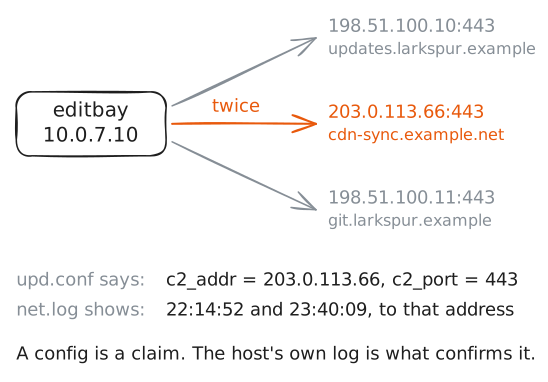
A tool has to reach the attacker to be useful, so the next edge runs Capability → Infrastructure. The tool shipped with a config file, and the host's own outbound log records where it actually went.
Infrastructure is the set of addresses and domains the attacker controls or borrows. Reading the config names the command-and-control (C2) address, the server the tool reports to and takes orders from; the outbound log confirms the victim really connected there, so you are not taking the config's word for it.
Read the config, then pull the matching line out of the outbound log.
editbay:~# cat /opt/.cache/upd.conf
editbay:~# grep 203.0.113.66 /var/log/editbay/net.log
-
Infrastructure to another victim: the pivot
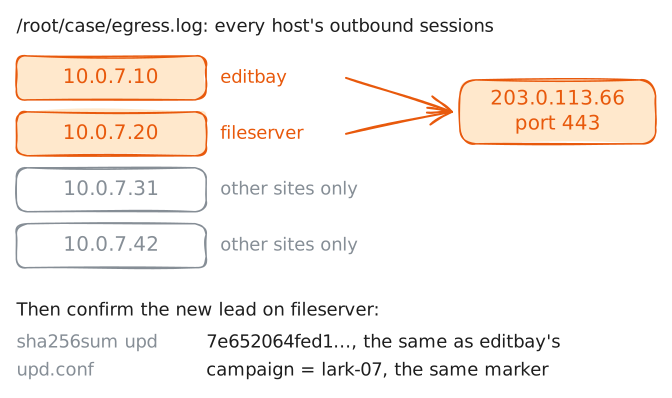
Here is the pivot the model exists for. You have one solid fact, the C2 address
203.0.113.66, and you run the edge Infrastructure → Victim: who else reached that address?The studio gateway keeps one egress log for every host, restored to
/root/case/egress.log. Searching it for the C2 address is a search across the whole network, not one host you picked in advance. Whatever internal address comes back alongside editbay is a lead the triage had not flagged.Grep the egress log for the address. One of the hosts it returns,
10.0.7.20, is Larkspur's shared asset server,fileserver; confirm the lead by hashing its copy of the tool and reading its config.editbay:~# grep 203.0.113.66 /root/case/egress.log fileserver:~# sha256sum /opt/.cache/upd fileserver:~# cat /opt/.cache/upd.conf
-
One address behind two names: enriching Infrastructure
One loose end remains. editbay's tool called
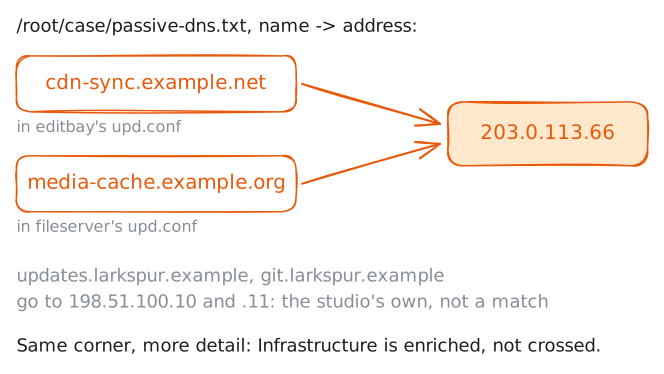
cdn-sync.example.net, but fileserver's calledmedia-cache.example.org: two different-looking domains. Are these two separate operations, or one?The lookup log answers it, and the move stays inside the Infrastructure corner. Both domains resolve to the same address, so you are not crossing to a new corner; you are enriching the one you have by pivoting on a shared resolution: a pivot within a corner, not a new edge.
The model does have an "infrastructure-to-infrastructure" term, but only as one value of direction, a meta-feature (an extra fact the model records about each event) that says which way an event's traffic ran. It is not a way to group names.
Pull every line for the C2 address out of the lookup log.
editbay:~# grep 203.0.113.66 /root/case/passive-dns.txt
-
The activity group, and the corner you don't fill
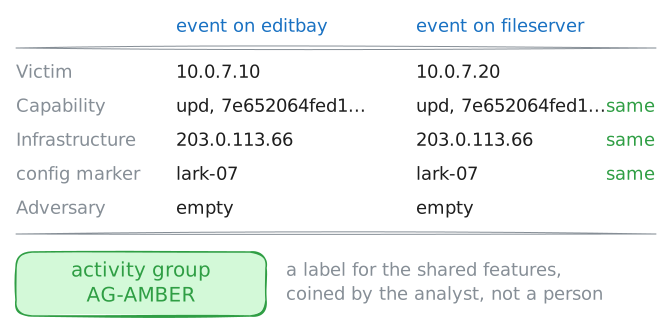
Step back and look at the whole graph. You have two events that share a Capability (the tool, by one hash) and an Infrastructure (one address behind two domains). Events that share chosen features are grouped into an activity group, the analyst's cluster of related events, which Soraya tracks under a label she coins,
AG-AMBER.A campaign, by contrast, is a time-bounded run of activity; the group is the adversary-centred cluster behind it.
The one corner still blank is Adversary, and that is correct, not a failure. Nothing on these hosts names a person. The config carries a
campaign = lark-07marker, but the adversary wrote that string themselves, so it supports the grouping without naming who is behind it.You leave the Adversary corner empty unless separate, strong identity evidence turns up. Read the worksheet of meta-features Soraya records for the group.
editbay:~# cat /root/case/meta.txt
Run these steps on real machines