 Hack the Route Start learning Open app
Cryptography at work
Encoding vs encryption
Obfuscation hides a payload with reversible transforms — base64, hex, a short XOR — that use no key, so unlike encryption it peels straight back to the original: encoding, not encryption.
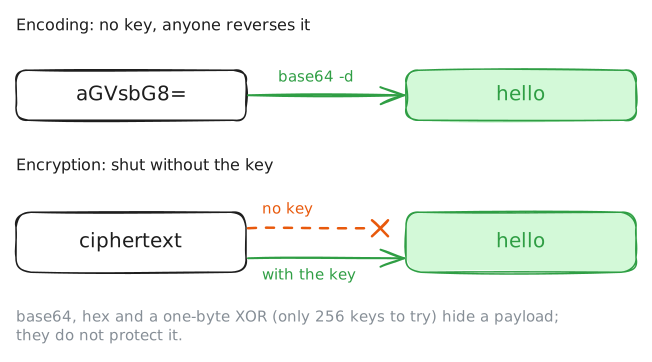
Encoding changes how data is written, with no key, so anyone can reverse it; encryption stays shut without the key. Base64 and hex are encodings: they hide a payload from a glance or a plain string match. A one-byte XOR has only 256 keys, so you try them all. Obfuscated scripts stack such layers; peel them one at a time, without running the sample, to reach the [[indicators-of-compromise|indicator]] inside.
Read next
- Cryptographic hash A one-way function that turns any data into a short fixed-size fingerprint, so the same bytes always give the same digest and no one can find two inputs that share one.
- Indicators of compromise (IOC) Concrete artifacts of an attack — an address, a file path, a hash — that you block and hunt for everywhere.
- Data states The three places a piece of data can be: kept on a disk (at rest), travelling between machines (in transit), or held by a running program (in use). Each needs its own protection.
- Tokenisation Swapping a sensitive value for a random stand-in, the token. The real value stays in one guarded place, the vault, and every other system holds the token.