 Hack the Route Start learning Open app
Security foundations
Tokenisation
Swapping a sensitive value for a random stand-in, the token. The real value stays in one guarded place, the vault, and every other system holds the token.
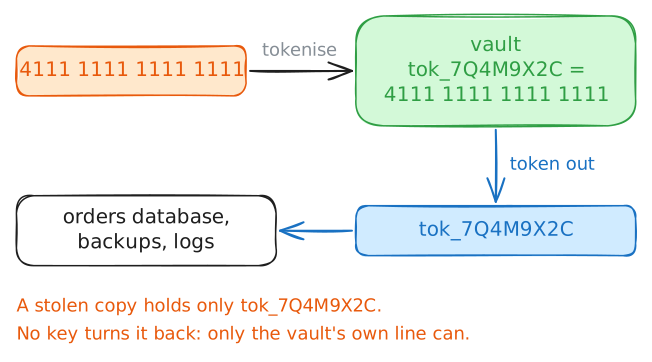
Tokenisation swaps a sensitive value, such as a card number, for a token: a random stand-in that contains
nothing of the original. The pair is kept in one guarded place, the vault; every other system stores the token.
Unlike encryption, no key turns a token back, only the vault's own lookup, so a copied database of tokens gives away
no values. The risk moves into the vault. Masking instead shows part of a value, ****6819. See
[[data-states]].
Read next
- Data states The three places a piece of data can be: kept on a disk (at rest), travelling between machines (in transit), or held by a running program (in use). Each needs its own protection.
- Encoding vs encryption Obfuscation hides a payload with reversible transforms — base64, hex, a short XOR — that use no key, so unlike encryption it peels straight back to the original: encoding, not encryption.
- Hashing, salting and key exchange The building blocks under TLS and passwords: one-way hashes, salts, key pairs and agreeing a key in public.