 Hack the Route Start learning Open app
Cryptography at work
Leaked private key
A private key is a credential in a file: copied out of a backup, a world-readable home or a git repo, it authenticates as the owner on every server that trusts its public half — and because the theft is a silent copy, nothing warns you it happened — so the only fix is to revoke it on the server and rotate to a fresh pair.
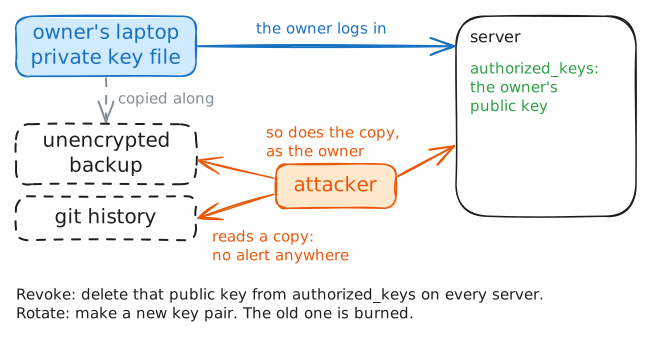
A leaked private key is a copy of a [[key-based-auth|key authentication]] private key in the wrong hands. The file is
the whole credential: whoever reads it logs in as its owner, and copying it triggers no alert. Keys leak through
backups, world-readable directories and git history. You cannot un-leak one: revoke it by removing its public key
from every authorized_keys, then rotate to a new pair. Scan repos with gitleaks.