 Hack the Route Start learning Open app
Passwords and hashes
Online credential guessing
Trying username/password pairs against a live service, as fast as it allows — and why it fails against hardened logins.
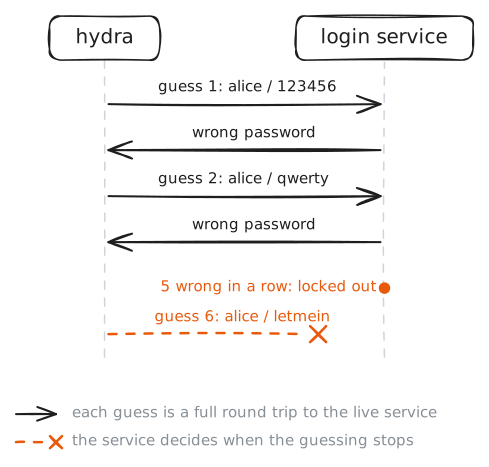
Online credential guessing tries username and password pairs against a live service, with tools like hydra or
medusa. Unlike offline [[password-cracking]], every guess is a round trip the service can count, so rate limits,
lockouts (fail2ban), a second factor or [[key-based-auth|key-only login]] stop it. Use the module that matches the
login: hydra's http-post-form for a web form, not http-get, which a page that always answers 200 fools.
Read next
- Key-based authentication Logging in with a private key whose public half the server trusts, instead of a password — so password guessing cannot work.
- Password cracking Recovering a password offline by hashing guesses from a wordlist (optionally mangled by rules) until one matches.
- Password strength and rate limiting Why guessable passwords fall to repeated tries, and the defences that stop them.
- Leaked private key A private key is a credential in a file: copied out of a backup, a world-readable home or a git repo, it authenticates as the owner on every server that trusts its public half — and because the theft is a silent copy, nothing warns you it happened — so the only fix is to revoke it on the server and rotate to a fresh pair.
- Password spraying Trying one likely password once against every account, so no account passes a lockout threshold and anyone who reused a weak shared secret is found.
- CMS takeover Chaining a CMS's ordinary conveniences — version disclosure, user enumeration, an unlocked login, admin plugin install — into full control of the site.