 Hack the Route Start learning Open app
Cryptography at work
HTTPS interception
Reading an HTTPS session from a box in the path by forging the server's certificate — which works only once the victim trusts the box's CA, and which certificate pinning defeats even then.
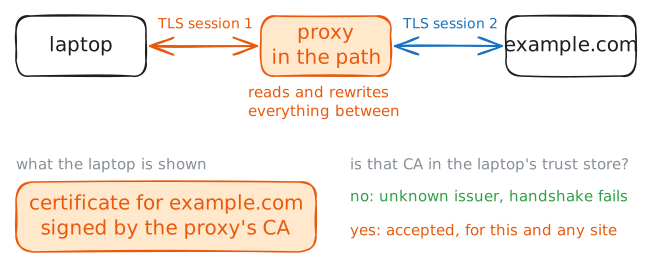
HTTPS interception reads a [[tls|TLS]] session from a proxy in the path, (mitmproxy). The proxy ends the client's TLS itself with a certificate it forges for the real name, and opens a second connection to the server. Its CA is unknown, so the client refuses, unless that CA is added to the [[trust-store|trust store]]; then every site opens. Pinning still refuses: the client expects the server's exact key. See [[man-in-the-middle]].
Read next
- TLS and certificates Encryption plus proof of identity: the server shows a certificate for the name, signed by a trusted authority.
- Trust store The list of root certificates a device trusts; every certificate it accepts chains to one of them.
- Certificate chain A server's certificate, signed by an issuing CA, whose certificate a root signed: the path a client follows to someone it trusts.
- Self-signed certificate A certificate whose issuer is its own subject: nobody vouches for it but itself.
- Man in the middle A machine placed on the path between two parties, able to read and alter what is not protected end to end.
- weak TLS configuration A server with a valid certificate that still accepts obsolete protocol versions (TLS 1.0/1.1) or weak cipher suites — a configuration flaw the padlock never shows, found by enumerating what the server offers and fixed by policy, not a new certificate.