 Hack the Route Start learning Open app
The idea
You are on the Kali box kali, with a signed engagement against Westhaven Dispatch. One host answers: their
operations server, running a status page on 80 and SSH on 22.
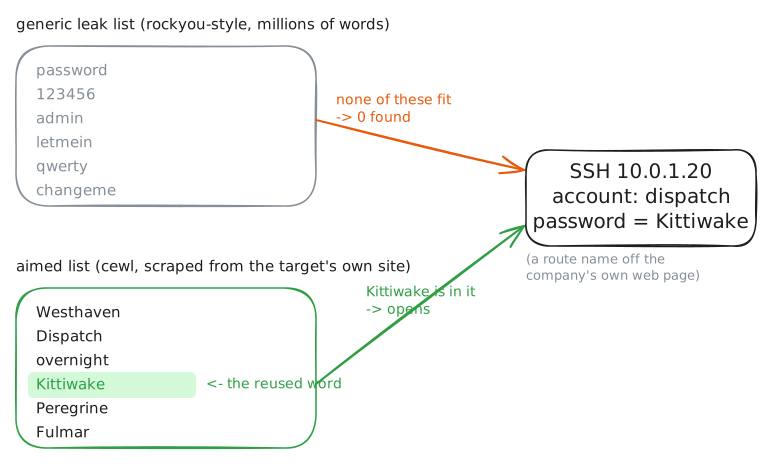
SSH takes passwords, so you could guess — but online credential guessing against a real box is usually a dead end. The accounts that matter hold long random passphrases no wordlist contains, and a loud guessing burst is exactly what a hardened login is built to refuse. The way in is not a bigger list, it is a sharper one: the word a courier coined for its own routes, printed on its own public page, and reused as a password on a door nobody rate-limited.
Steps
-
Which door even takes a guess
Online guessing attacks a live service, one round trip per attempt, so the first question is which services are even listening and which of them take a password at all. A fast port scan answers it.
nmapasks each port whether something answers. Guessing only makes sense where a password is checked: SSH, a web login, a database. A static status page is not a login, however open the port — so the scan tells you which door is even worth a guess.kali:~# nmap -Pn -n -p22,80 10.0.1.20
-
A generic list bounces off
The lazy move is a generic password list — the millions of real-world passwords in a leak like
rockyou. Against Westhaven it is hopeless, and it is worth watching it fail so you understand why the next step works.hydra throws credentials at a live service for you:
-lsets one username,-Pa password file, and thessh://module speaks the SSH login. Point it at the shareddispatchaccount with a handful of the usual suspects. A generic list holds passwords people reused from other sites; it does not hold a word a company coined for itself, so a courier's own route name is nowhere in it.kali:~# printf '%s\n' password 123456 admin letmein qwerty courier changeme > /tmp/common.txt kali:~# hydra -l dispatch -P /tmp/common.txt ssh://10.0.1.20
-
Harvest the company's own words
The fix for a list that holds the wrong words is to build one from the right source: the target's own site. cewl crawls a web page and writes out every distinct word it finds, which is exactly the vocabulary a staff member reaches for when inventing a password they will remember — a route name, a product, the town.
This is Wordlist profiling: a small list, but aimed.
-d 1follows links one level deep,-m 5keeps words of five letters or more, and-wwrites the result to a file. Read what it harvests — the route names from the status page are right there.kali:~# cewl -d 1 -m 5 -w /tmp/words.txt http://10.0.1.20/ kali:~# cat /tmp/words.txt
-
The reused word falls
Now run the same hydra, the same account, with the aimed list instead of the generic one. A list of a few dozen company words finishes in seconds, and where fourteen million generic passwords missed, one scraped route name fits.
This is the whole lesson of online guessing against a real target: brute force by volume loses to a hardened login, but an aimed guess beats a reused word every time. When hydra reports a valid pair, confirm it is real by logging straight in with it.
kali:~# hydra -l dispatch -P /tmp/words.txt ssh://10.0.1.20
kali:~# sshpass -p Kittiwake ssh -o StrictHostKeyChecking=no dispatch@10.0.1.20 id
-
What the server's log shows — and the fix
Switch seats. Every one of those guesses hit a real sshd, which wrote a line for each. On the ops server the auth log tells the whole story: a burst of failures from one address, then an acceptance.
That pattern — many failures then a success, all from the same source in seconds — is what a defender watches for, and it points straight at the three fixes, none of which is "use a longer generic blocklist":
- Do not reuse a scrapeable word. The only reason the guess worked is that
dispatchused a route name off the public site. A random passphrase from a manager is not on any list, aimed or generic. - Rate-limit the login. Nothing stood in front of port 22, so hydra could guess as fast as sshd allowed.
A lockout after a few failures (fail2ban, or an
iptablesrate limit) turns a seconds-long attack into a hopeless one — you close that gap yourself in the practice tasks. - Prefer keys to passwords.
PasswordAuthentication nowith key-only login offers an online guesser no method to attack at all.
Running this same guessing against a system whose owner has not authorised you in writing is an offence under laws like the UK Computer Misuse Act and the United States' CFAA — the engagement letter is what makes it a test and not a crime.
opshost:~# grep -E 'Failed password|Accepted password' /var/log/auth.log | tail -n 12
- Do not reuse a scrapeable word. The only reason the guess worked is that
Run these steps on real machines
Keep reading
- Kali Tools: hydra article
- Kali Tools: cewl article
- OWASP: Blocking Brute Force Attacks article