 Hack the Route Start learning Open app
The idea
Thea is the duty analyst at the Carrick Water Board. Overnight, a monitoring rule flagged a spike of failed SSH logins on the readings historian, the server that records water-treatment measurements.
A flagged spike is a signal, not a verdict. Identification is the phase that turns it into a decision: is this a real incident or routine noise, and if it is real, how bad is it and how far could it reach? Thea answers those questions from the historian's own evidence before she declares anything, because the facts she gathers now are what the containment team will act on next.
Steps
-
A spike of failures is a signal, not a verdict
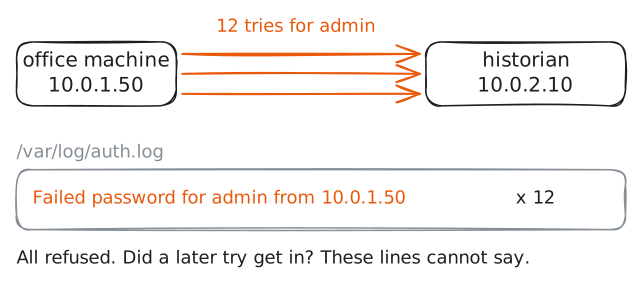
The rule fired on a count: too many failed logins in too short a time. That is enough to look, not enough to conclude. The evidence behind the count is the historian's login record,
/var/log/auth.log, where every refused attempt leaves a line naming the account tried and the address it came from.Thea pulls the failures first, to see the shape of what the rule noticed.
historian:~# grep 'Failed password' /var/log/auth.log
-
The question that settles it: did any attempt land?
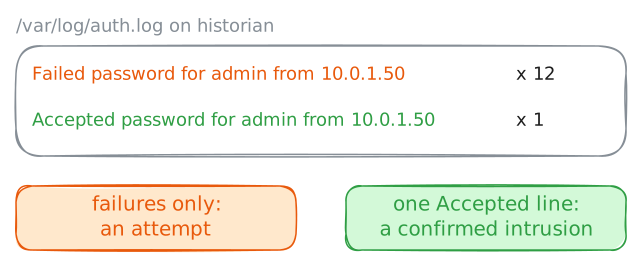
A brute force matters only if one of the guesses was right. The same log that holds the failures holds the successes, under a different word: an accepted login reads
Accepted password, notFailed password.This is the single check that turns a suspicious spike into a confirmed incident. Thea searches for an acceptance from the same source.
historian:~# grep 'Accepted password' /var/log/auth.log
-
How big, and how bad?
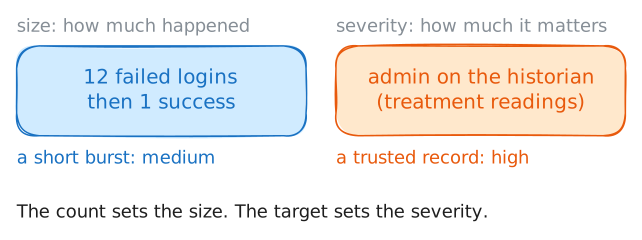
A confirmed incident still needs a size and a severity before anyone can prioritise it. Size is how much happened; severity is how much it matters.
For size, count the attempts.
grep -creports the number of matching lines instead of printing them, so it answers "how many failures" in one number. For severity, Thea weighs what the taken account controls:adminon the historian that records the water-treatment readings the whole site trusts.historian:~# grep -c 'Failed password' /var/log/auth.log
-
How far could it spread? Then declare
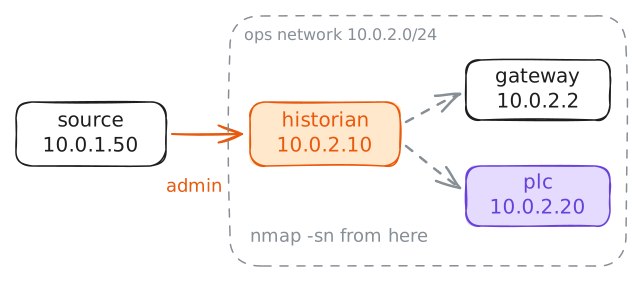
The last identification question is blast radius: standing where the attacker now stands, what else is within reach? An intruder who holds one machine rarely stops there. They look for the next one.
Thea asks the question from the historian itself, by sweeping its own network for other hosts the attacker could try to move to.
historian:~# nmap -sn 10.0.2.0/24
Run these steps on real machines