 Hack the Route Start learning Open app
The idea
Delphine runs an authorised penetration test for Marsh & Vale, a recruitment firm, and has pulled a copy of the
hiring portal's users table. The app kept no plaintext — it stored a hash of each
password — so at first glance the accounts look safe.
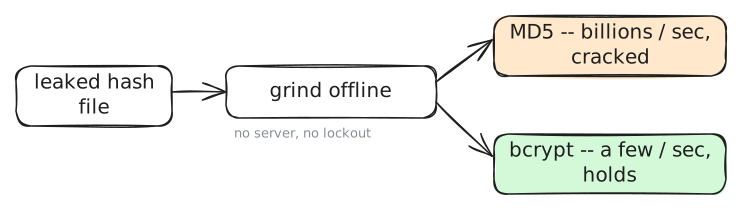
They are not. The store used raw, fast hashes, so this is offline cracking: you hash
guesses from a wordlist and compare, millions a second, with no live server to slow you down. You'll name each hash
by its shape, point john and the real rockyou leak at the fast ones, and watch most of the table fall — then
meet the one row that does not, and see why.
Delphine only runs these tools against systems Marsh & Vale has authorised her to test in writing. Pointing a cracker at a hash taken from a system whose owner has not authorised you in writing is a crime, not a lab exercise.
Steps
-
The dump you pulled off the portal
You're on your Kali box,
kali, with the captured table saved at/home/kali/loot/users.txt: oneusername:hashrow per account, no salt and no column saying which algorithm made each hash. Read it and look at the hashes, not the names.The rows are not all the same length. The portal changed how it hashed passwords over the years and never re-hashed the old accounts, so the table is a museum of its own history — the oldest rows short, the newest long and oddly shaped. That mix is your first piece of information.
kali:~# cat /home/kali/loot/users.txt
-
Name each hash by its shape
Before cracking anything, name the algorithm — because a cracker has to be told the type, and the wrong guess wastes the whole run.
hashidreads a hash and lists the formats that match its shape; with-mit also prints thehashcatmode number you would pass as-m. This lab cracks withjohn(it takes the type as--format), and the very same identification feedshashcat's-mwhen you reach for that instead.Run it on the two extremes: the 32-character
i.adminhash, and the$2y$row. A 32-hex digest is MD5, 40 is SHA-1, 64 is SHA-256, and a$2y$prefix is bcrypt — a password hash in a different class, which the last step comes back to.kali:~# hashid -m '5f4dcc3b5aa765d61d8327deb882cf99' kali:~# hashid -m '$2y$10$VQOFL03vj92nQ6OHy7CLFOTTaEfCtKjeRnyc.POC7JBXO.JPLsfEi'
-
Point rockyou at the MD5 rows
john(John the Ripper) hashes every word in a wordlist with the format you name and compares each result to the stored hashes. The wordlist to reach for first isrockyou.txt— the real 14-million-password leak that ships on this box at/usr/share/wordlists/rockyou.txt— because it holds the passwords people actually chose.Point it at the two MD5 rows. A fast hash with no stretching — no repeated rounds to slow each guess down — is almost free to compute, so john tears through the common end of rockyou in well under a second.
kali:~# john --format=raw-md5 --wordlist=/usr/share/wordlists/rockyou.txt --pot=/tmp/md5.pot /home/kali/loot/md5.txt
kali:~# john --show --format=raw-md5 --pot=/tmp/md5.pot /home/kali/loot/md5.txt
-
The SHA-1 and SHA-256 rows fall the same way
SHA-1 and SHA-256 are longer digests, but they are still fast, unsalted hashes, so nothing about the attack changes — only the
--formatyou hand john. Run it twice more: once for the 40-hex rows asraw-sha1, once for the 64-hex rows asraw-sha256.This is the whole point of naming the hash first. Give john the right format and the rows fall in a blink; give it the wrong one and it loads nothing and reports failure on hashes that were never in danger.
kali:~# john --format=raw-sha1 --wordlist=/usr/share/wordlists/rockyou.txt --pot=/tmp/sha1.pot /home/kali/loot/sha1.txt
kali:~# john --format=raw-sha256 --wordlist=/usr/share/wordlists/rockyou.txt --pot=/tmp/sha256.pot /home/kali/loot/sha256.txt
kali:~# john --show --format=raw-sha1 --pot=/tmp/sha1.pot /home/kali/loot/sha1.txt; echo ---; john --show --format=raw-sha256 --pot=/tmp/sha256.pot /home/kali/loot/sha256.txt
-
The bcrypt row that will not fall
One account is left:
t.vale, the$2y$bcrypt row. Run john against it with rockyou, but cap the run at a few seconds — because bcrypt is built to be slow. Where raw MD5 let john try millions of guesses a second, bcrypt's cost factor — a dial that sets how many rounds each hash runs — drags that down to a few hundred, on purpose.So two things defeat you here at once: the hash is slow, and the CEO's passphrase is long and random, in no wordlist on earth. Even left running for weeks against all of rockyou, this would never land.
kali:~# john --format=bcrypt --wordlist=/usr/share/wordlists/rockyou.txt --max-run-time=8 --pot=/tmp/bc.pot /home/kali/loot/bcrypt.txt
kali:~# john --show --format=bcrypt --pot=/tmp/bc.pot /home/kali/loot/bcrypt.txt
Run these steps on real machines