 Hack the Route Start learning Open app
The idea
Silas keeps the member database for Lindow Fitness, the gym on the high street, and this morning a copy of its password table turned up on a forum. The table holds no plaintext, only a hash of each password, so the owner wants to tell members their passwords are safe. Silas wants to check before anyone sends that email.
Read the leak the way an attacker would, crack it, and then rebuild the store the way it should have been: a per-user salt, and a hash slow enough that each guess costs real time.
Steps
-
The member table that leaked
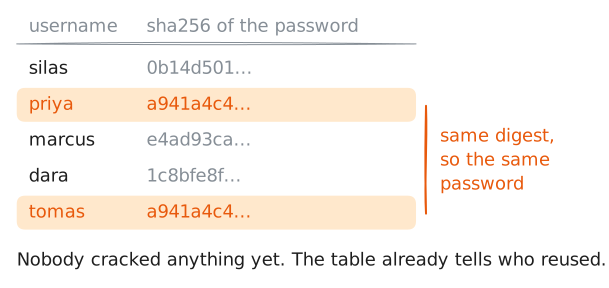
A password store should never hold plaintext. Silas's holds a SHA-256 of each member's password, one row per account, so a leaked copy doesn't hand the passwords over directly. You'd have to reverse the hash, and you can't.
That's the theory. Read the leaked table and look at the digests themselves before you try to break anything.
host:~# cat /srv/members.csv
-
The same password always hashes the same
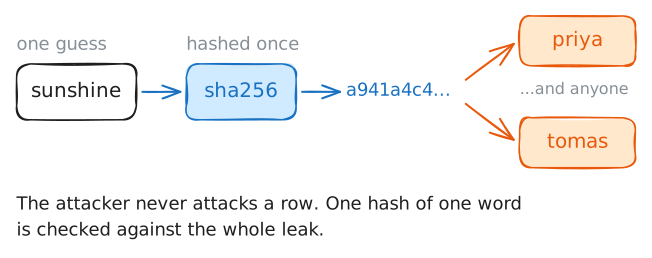
Because the hash is deterministic, an attacker doesn't have to attack each row. They can hash a guess once and see whether its digest shows up in the leak. That single digest matches every account that used that password.
Try it with one common guess. Hash the word
sunshineand compare its digest to the pair you saw.host:~# openssl dgst -sha256 -r /srv/guess
-
A precomputed table reads the passwords out
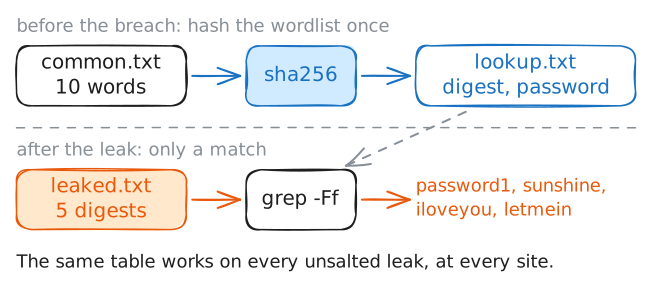
An attacker doesn't guess one word at a time. Ahead of the breach they hash a whole wordlist of common passwords once and save the
digest → passwordpairs: a lookup table (its space-saving cousin is a rainbow table). After a leak they match the stolen digests against it and read the answers off, with no work per account.The table is already built at
/srv/lookup.txt, and the leaked digests pulled out at/srv/leaked.txt. Match one against the other.host:~# grep -Ff /srv/leaked.txt /srv/lookup.txt
-
A salt per account breaks the table
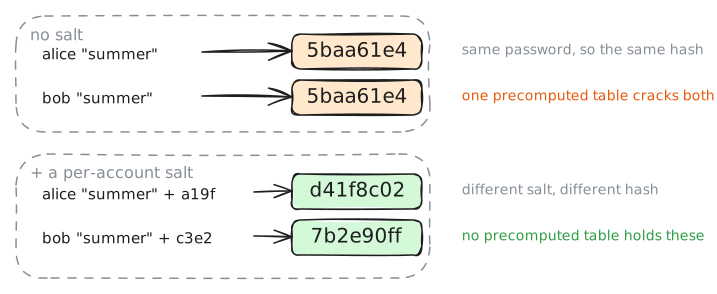
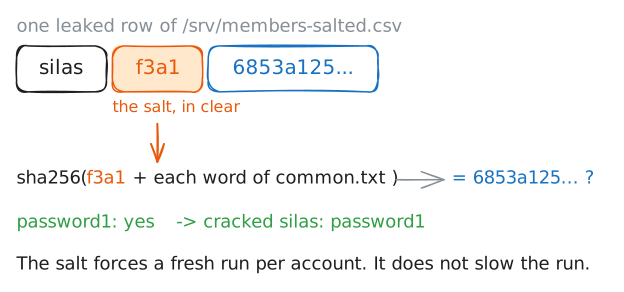
Silas rebuilds the store with a salt: a short random value, different for every account and stored in clear beside the hash. Instead of
sha256(password)the store now holdssha256(salt + password).The salt isn't a secret: it sits right there in the table. Its job is to make every account hash differently even when the passwords are the same. Point the same precomputed table at the new store and read the rebuilt rows.
host:~# cat /srv/members-salted.csv
host:~# grep -Ff /srv/leaked-salted.txt /srv/lookup.txt
-
Salted but fast: one account still cracks
The salt stopped precomputation, not guessing. Since the salt is stored in clear, an attacker who targets one account reads that account's salt from the leak, then hashes the wordlist with it until a digest matches. SHA-256 is fast: a laptop's graphics card can run it hundreds of millions of times a second, so a common password still falls at once.
Here's that attack as a short script. Read what it does, then run it against
silas.host:~# python3 /srv/crack-fast.py
-
Stretch the hash so each guess costs
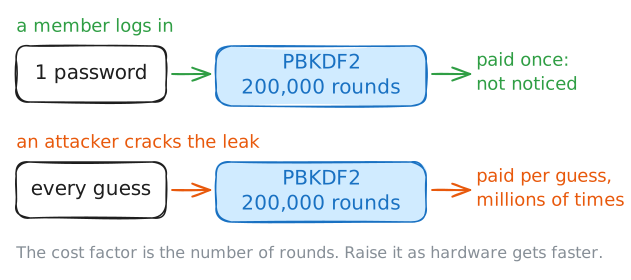
The answer is key stretching: hash passwords with a function that is slow on purpose, such as
bcrypt,scrypt,argon2orPBKDF2, instead of a bare SHA-256. It runs the password through many thousands of rounds, set by a cost factor. Raise the cost and every hash takes longer. The honest login checks one password and never notices. The attacker, who must try millions, has their guess rate cut by the same factor.Measure it. This script counts how many bare SHA-256 hashes and how many PBKDF2 hashes at 200,000 rounds this machine does in a second.
host:~# python3 /srv/stretch-cost.py
Run these steps on real machines