 Hack the Route Start learning Open app
Security foundations
Threat modelling
A review of a design before it goes into use: draw how data moves, mark where trust changes, ask a fixed list of questions at each crossing, and decide what to do about each answer.
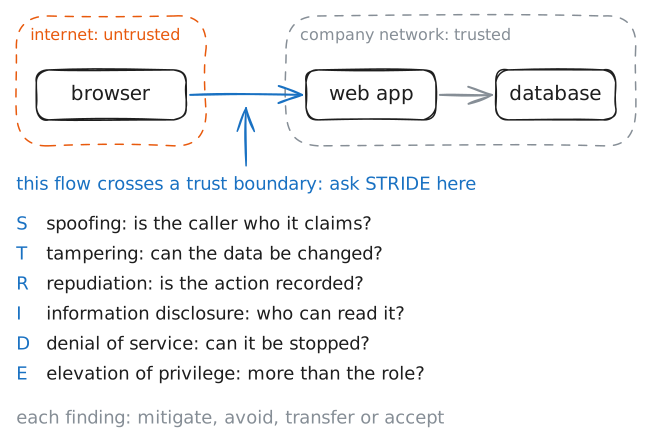
Threat modelling is a review of a design for weak spots before it goes into use. Draw a data-flow diagram: the programs, data stores, people and every path data takes. Mark each trust boundary, where trust changes. At every flow crossing one, ask the six STRIDE questions: spoofing, tampering, repudiation, information disclosure, denial of service, elevation of privilege. Each finding gets a decision: mitigate ([[security-control-types]]), avoid, transfer or accept. Redraw when the system changes.
Read next
- CIA triad The three promises a system makes about its data and service: confidentiality, integrity and availability.
- Defense in depth Overlapping controls so that when one fails, another still catches or contains the attack.
- Security control types Controls sorted by the job each does (prevent, deter, detect, correct, direct, compensate) and by who or what carries each out.
- Vulnerability classes Vulnerabilities sorted by kind, because the kind decides the fix: patch, change, reconfigure, validate, or rotate and remove.