 Hack the Route Start learning Open app
Security foundations
CIA triad
The three promises a system makes about its data and service: confidentiality, integrity and availability.
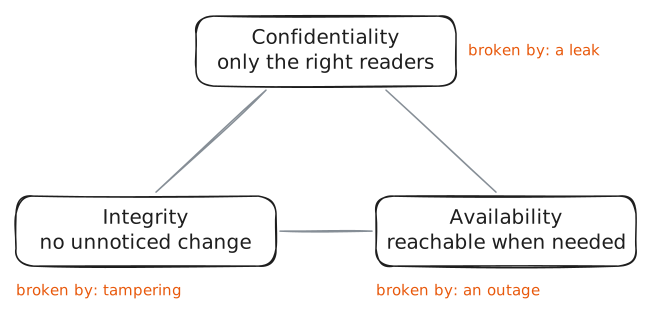
The CIA triad names the three promises a system makes about its data. Confidentiality: only the right people can read it; a leak breaks it. Integrity: it has not been changed unnoticed; tampering breaks it, and a recorded hash ([[file-integrity-monitoring]]) catches it. Availability: the right people can reach it; an outage or ransomware breaks it. They pull against each other: taking a service offline to protect it gives up availability.
Read next
- Defense in depth Overlapping controls so that when one fails, another still catches or contains the attack.
- File integrity monitoring Recording a fingerprint of trusted files while a host is known-good, then checking later which ones have changed.
- True and false positives An alert's worth is how often it is a real attack versus noise, which decides whether anyone acts on it.
- Rules of engagement The signed document that says which systems a tester may touch, how, and when — the line between a penetration test and a crime.
- Threat actor Whoever is behind an attack, sorted by kind: inside or outside, what they want (motivation), and the skill, time and money they bring (capability).
- Security control types Controls sorted by the job each does (prevent, deter, detect, correct, direct, compensate) and by who or what carries each out.
- Threat modelling A review of a design before it goes into use: draw how data moves, mark where trust changes, ask a fixed list of questions at each crossing, and decide what to do about each answer.
- Data states The three places a piece of data can be: kept on a disk (at rest), travelling between machines (in transit), or held by a running program (in use). Each needs its own protection.