 Hack the Route Start learning Open app
Security foundations
Security control types
Controls sorted by the job each does (prevent, deter, detect, correct, direct, compensate) and by who or what carries each out.
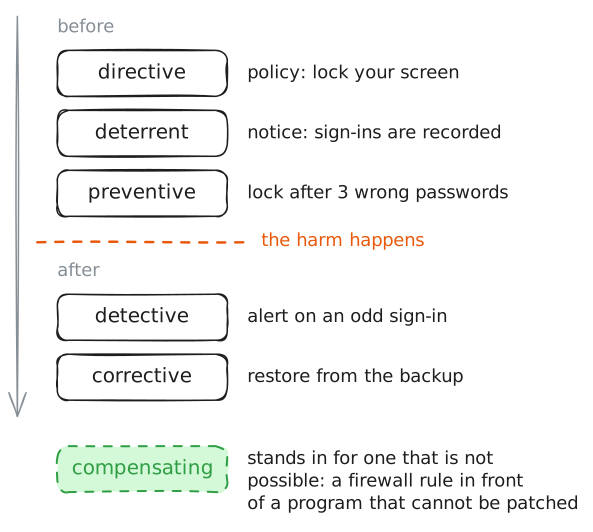
Security control types sort safeguards by the job each does. Preventive stops harm before it happens (an account lockout). Deterrent discourages (a warning notice). Detective notices (a log, an alert). Corrective repairs afterwards (a restore from backup). Directive tells people what to do (a written policy). Compensating stands in for a control that is not possible. The category says who carries a control out: technical, managerial, operational or physical. Stacking controls is [[defense-in-depth]].
Read next
- Defense in depth Overlapping controls so that when one fails, another still catches or contains the attack.
- Vulnerability classes Vulnerabilities sorted by kind, because the kind decides the fix: patch, change, reconfigure, validate, or rotate and remove.
- CIA triad The three promises a system makes about its data and service: confidentiality, integrity and availability.
- Threat actor Whoever is behind an attack, sorted by kind: inside or outside, what they want (motivation), and the skill, time and money they bring (capability).
- Threat modelling A review of a design before it goes into use: draw how data moves, mark where trust changes, ask a fixed list of questions at each crossing, and decide what to do about each answer.
- KEV and EPSS Two public feeds that say whether a flaw is being used: KEV lists flaws seen in real attacks, EPSS forecasts the chance of use in the next 30 days.