 Hack the Route Start learning Open app
Security foundations
Vulnerability classes
Vulnerabilities sorted by kind, because the kind decides the fix: patch, change, reconfigure, validate, or rotate and remove.
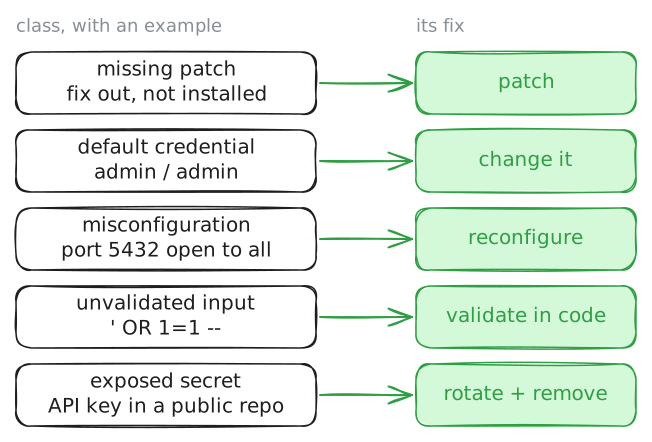
A vulnerability class is a kind of weak spot, and the kind decides the fix. A missing patch is a known flaw whose fix was never installed: patch ([[vulnerability-management]]). A [[default-credentials|default credential]] shipped with the product: change it. A misconfiguration is a setting wider than the job needs: reconfigure. Unvalidated input is the root of [[sql-injection]]: validate in the code. An exposed secret is a key left readable: rotate and remove it. Which finding to fix first is a different question ([[cvss]]).
Read next
- Vulnerability management The ongoing loop of scanning a host for weaknesses, prioritising them, fixing them, and rescanning to confirm.
- Default credentials The username and password a device or appliance ships with — a confirmed way in whenever nobody changes it before the box goes live.
- CVSS and CVE A CVE names a specific known vulnerability; its CVSS score rates how severe it is, so findings can be prioritised.
- Threat actor Whoever is behind an attack, sorted by kind: inside or outside, what they want (motivation), and the skill, time and money they bring (capability).
- Security control types Controls sorted by the job each does (prevent, deter, detect, correct, direct, compensate) and by who or what carries each out.
- Threat modelling A review of a design before it goes into use: draw how data moves, mark where trust changes, ask a fixed list of questions at each crossing, and decide what to do about each answer.
- KEV and EPSS Two public feeds that say whether a flaw is being used: KEV lists flaws seen in real attacks, EPSS forecasts the chance of use in the next 30 days.