 Hack the Route Start learning Open app
The idea
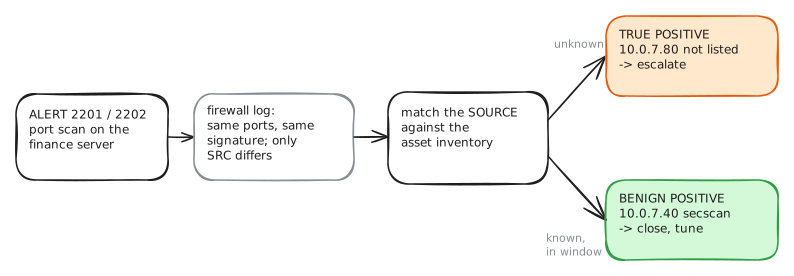
Imani is on shift in Castleford University's security operations centre (SOC), and the port-scan rule has fired against the finance server. An alert is not a verdict: it is a hypothesis that something might be an attack.
Her job is to pull the evidence behind each alert and decide what it is: a true positive to escalate, a benign positive to close, or a false positive that means the rule itself is broken. Partway through she takes the security team's scanner and runs its sweep herself, so one of the alerts is evidence she made.
Steps
-
An alert is a hypothesis, not a verdict
Every alert is a claim: this traffic looks like an attack. Checking the claim ends in one of three verdicts:
- True positive: a real attack, caught.
- Benign positive: real activity the rule caught correctly, but it was authorised.
- False positive: the activity the alert claims never happened. The rule's logic or its data was wrong.
The worst case raises nothing at all: a false negative, an attack the sensor missed.
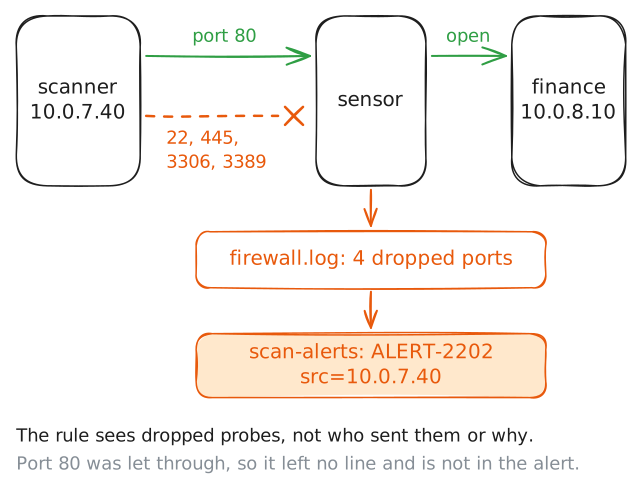
The sensor here is a firewall. It lets web traffic through to the finance server, drops everything else, and writes one line per dropped packet to
/var/log/firewall.log.The SOC's port-scan rule,
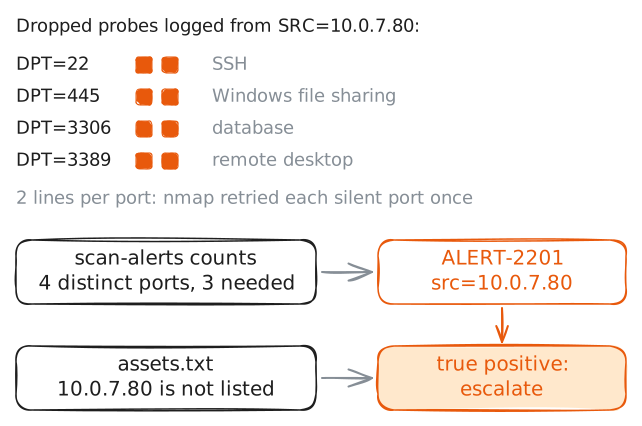
scan-alerts, reads that log. It raises an alert, its signature, when one source has probes dropped on three or more ports of one server.Run the rule, then read what the SOC already knows about its own network: the asset inventory.
sensor:~# scan-alerts
sensor:~# cat /etc/soc/assets.txt
-
Alert 2201: an unknown host
An alert line is a summary. The evidence behind it is the firewall log, one line per dropped probe, and a port scan shows up there as a burst of drops from one source to many ports.
The log is trimmed to the fields triage needs: time, source, destination and ports. A real firewall log carries more, such as the interface and TTL. Pull alert 2201's lines by its source.
sensor:~# grep 'SRC=10.0.7.80' /var/log/firewall.log
-
Alert 2202: run the scanner's sweep yourself
Take the other seat.
scannerissecscan, the security team's box, and its sweep is booked for today. Run that sweep from it, then run the rule again onsensorand watch your own traffic raise an alert.The rule cannot see the inventory. It sees only dropped probes, so the same five-port sweep should look exactly like 2201 to it.
scanner:~# nmap -n -Pn --max-retries 1 -T4 -p 22,80,445,3306,3389 10.0.8.10
sensor:~# scan-alerts
-
Same signature, opposite verdicts
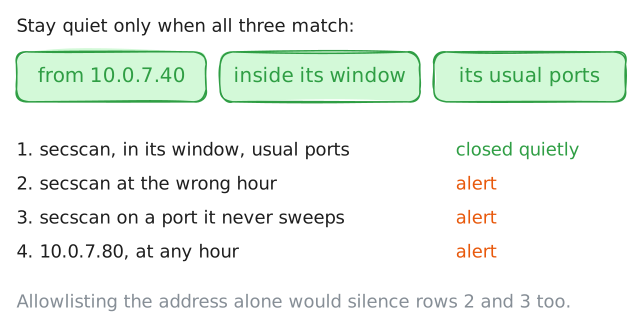
Lay the two scans side by side in the log. Both swept the finance server's database port; both are a burst of drops the sensor caught. The firewall log alone cannot tell you which one mattered.
What separated them was the asset inventory: context Imani brought, not anything the alert contained.
sensor:~# grep 'DPT=3306' /var/log/firewall.log
Run these steps on real machines