 Hack the Route Start learning Open app
The idea
Femi looks after the network at Marigold Gardens, a care home. This morning the security feed flagged a path that
scanning kits probe for, /server-status, and the lobby kiosk keeps asking the resident portal for it. A sensor
on a mirror can only tell Femi about it afterwards. Femi wants it stopped, without cutting the care floor off from
the portal.
So the same Suricata moves onto the path, into the gateway that forwards every packet between the floor and
the portal. There it becomes an IPS: it holds each packet in a netfilter queue until it says
accept or drop. You start it watching, change one word in a rule from alert to drop, and decide what
happens if it dies.
Steps
-
On the path, not beside it
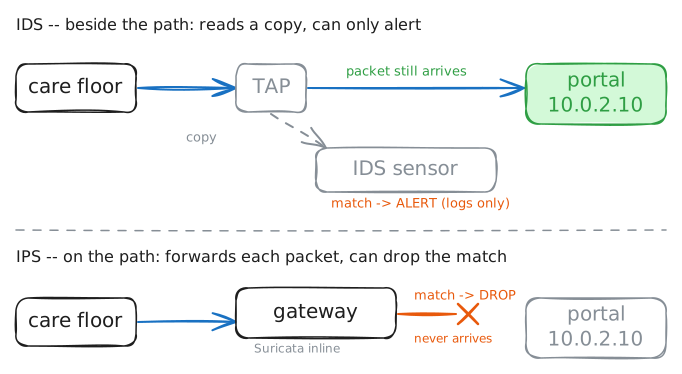
A sensor on a mirror port sits off to the side, reading copies. It can raise an alert, but the real packet has already gone on.
The gateway is different. It forwards every packet between the care floor (10.0.1.0/24) and the portal (10.0.2.10), so whatever the gateway decides about a packet is final.
That is the difference between an intrusion detection system (IDS) and an intrusion prevention system (IPS). The engine can be the same. What changes is where it sits. Watch a request from the care desk reach the portal, and trace the path it takes.
careDesk:~# traceroute -n 10.0.2.10
careDesk:~# curl -sS http://10.0.2.10/
-
Into the queue: every packet waits for a verdict
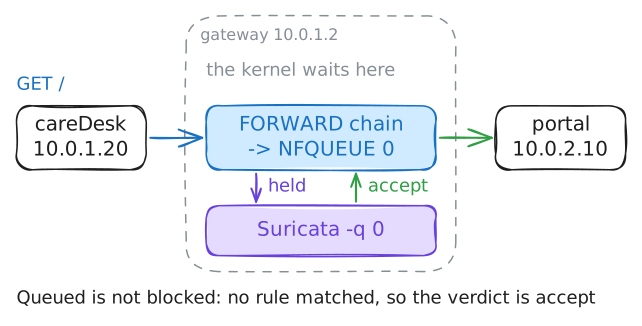
On the mirror, Suricata read copies off a network card. Inline, it reads a netfilter queue instead. One iptables rule in the
FORWARDchain hands every forwarded packet to queue 0 (NFQUEUE). The kernel holds each packet there until Suricata answers accept or drop, then does what Suricata said.That answer is the verdict.
Femi starts carefully, with one rule whose action is
alert: the queue works, but nothing is blocked yet. The iptables rule also gets--queue-bypass, a safety valve. If nothing is reading the queue, the kernel lets packets through instead of holding them. The last step tests that valve.gateway:~# cat /etc/suricata/rules/local.rules gateway:~# suricata -c /etc/suricata/netlab.yaml -q 0 -D -l /var/log/suricata gateway:~# grep -E 'rules successfully loaded|Engine started' /var/log/suricata/suricata.log gateway:~# iptables -I FORWARD 1 -j NFQUEUE --queue-num 0 --queue-bypass careDesk:~# curl -sS http://10.0.2.10/
-
Alert watches, drop blocks
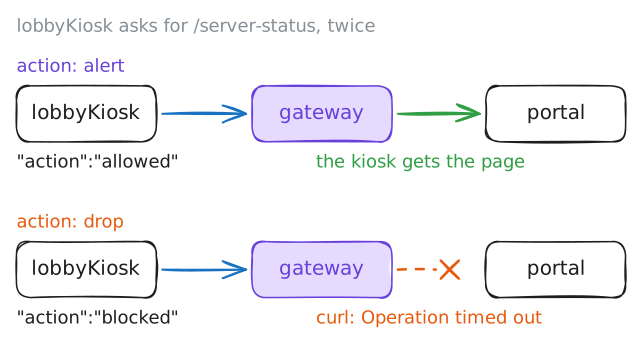
Suricata is inline now, but the rule's action is still
alert. Analertrule writes a log line and accepts the packet, even on the path. The first word of the rule, the action, decides what happens to a packet that matches.First see the kiosk's request get through under
alert. Then Femi changesalerttodrop, reloads the rules live, and the kiosk tries again. The pattern, the port and the direction stay the same. Only the action changes.lobbyKiosk:~# curl -sS http://10.0.2.10/server-status gateway:~# jq -c 'select(.event_type=="alert") | {action: .alert.action, url: .http.url}' /var/log/suricata/eve.json lobbyKiosk:~# curl -sS -m6 http://10.0.2.10/server-status gateway:~# cat /var/log/suricata/fast.log gateway:~# jq -c 'select(.event_type=="alert") | {action: .alert.action}' /var/log/suricata/eve.json -
Only the match is stopped
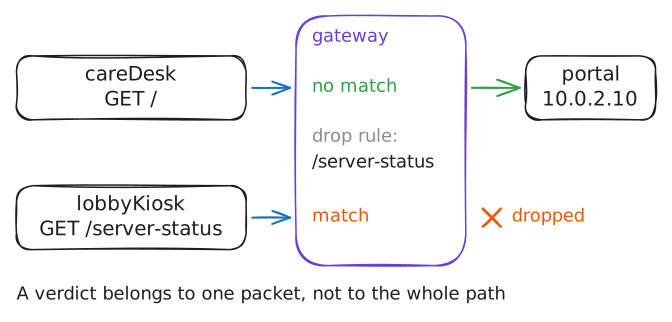
Femi's real worry is the care floor. Nurses use the portal all day, and they must not notice any of this.
A
dropverdict applies to the matching packet only. Every other packet still gets its own verdict, and with no matching rule that verdict is accept.This is also why a careless rule is dangerous inline. A pattern that matches too much drops real traffic and takes the floor down. On a mirror, too broad a rule makes noise. On the path, it makes an outage.
careDesk:~# curl -sS http://10.0.2.10/
lobbyKiosk:~# curl -sS -m6 http://10.0.2.10/server-status
-
Fail open, or fail closed
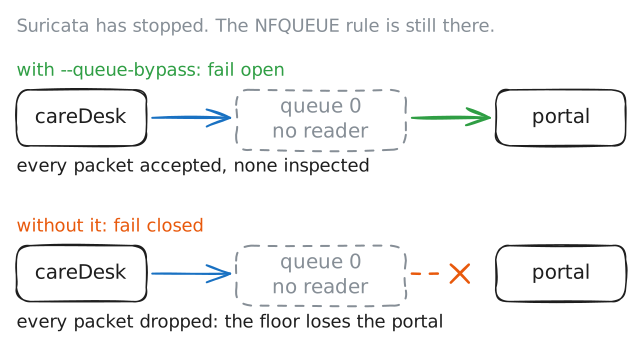
A sensor on a mirror can crash and nobody on the floor notices. An inline one forces a question: what happens to the traffic when Suricata dies?
The kernel has two choices. It can accept packets when nothing reads the queue, which is fail open: the network stays up, but nothing inspects it. Or it can drop them, which is fail closed: nothing gets past unchecked, because nothing gets past at all.
--queue-bypasspicks between the two. A loss meter pings the portal from the care desk while the lab stops Suricata and leaves the NFQUEUE rule in place.careDesk:~# ping -i 0.2 -c 80 -W 1 10.0.2.10 gateway:~# iptables -L FORWARD 1 -n