 Hack the Route Start learning Open app
The idea
Gideon runs a security review for Calderbank Energy, a regional power supplier. Their customer portal passes every glance: the certificate is valid, the browser shows a padlock, nobody has complained.
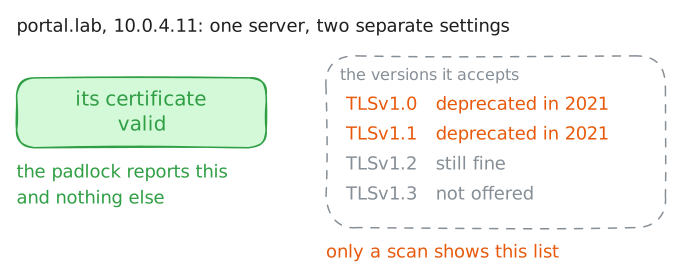
A padlock only means the certificate checked out, though. It says nothing about which versions and ciphers the server will still agree to, and that answer is where old servers give themselves away.
Gideon scans the portal the way an auditor does, reads what it offers, and proves the weakest part is live by completing a handshake no current client would ask for. Then he measures it against a portal that was configured this decade, and ends on the change that turns one into the other: a configuration edit, not a new certificate.
The portals and the network are the lab's own. Outside a lab, you scan only a system whose owner has authorised you in writing. Calderbank signed Gideon's engagement letter last week.
Steps
-
What the padlock does not tell you
A browser makes one check and shows one icon: does the certificate chain to a trusted root? It does not report the protocol versions the server still allows, or the cipher suites (the sets of algorithms that protect a session) it will negotiate. A server can hold a flawless certificate and still agree to TLS 1.0 from 1999.
nmap'sssl-enum-ciphersscript asks the server for every version and cipher it supports, one at a time, and prints the lot. Run it against the portal and read what comes back.laptop:~# nmap --script ssl-enum-ciphers -p 443 portal.lab
-
Proving the old protocol is really on
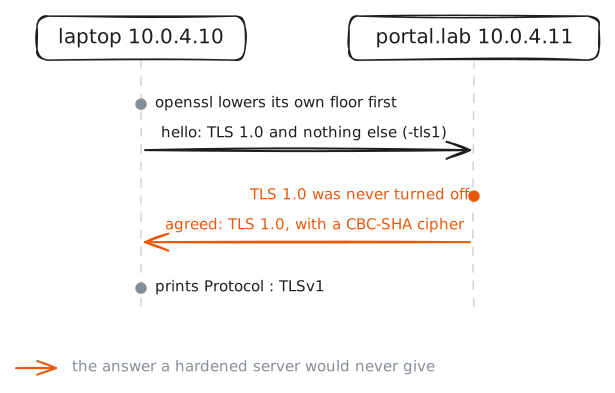
A scanner can over-report, so an auditor confirms the headline finding by hand: complete a handshake that only an obsolete client would offer.
openssl s_clientopens a TLS connection and prints what was negotiated.Current OpenSSL refuses to ask for TLS 1.0 by default, the same guard the portal is missing, so the command lowers OpenSSL's own floor first. If the server answers, the version is not only advertised, it is live.
laptop:~# openssl s_client -connect portal.lab:443 -tls1 -cipher DEFAULT:@SECLEVEL=0
-
Reading a cipher suite
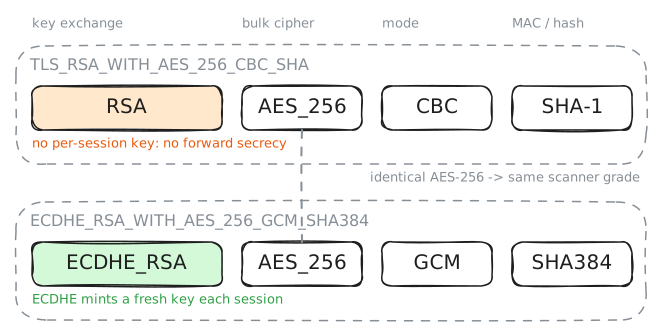
Every field in a cipher name is a decision the two sides agreed on. Force the portal onto one of its RSA suites and take the name apart. OpenSSL calls this suite
AES256-SHA, and its standard (IANA) name isTLS_RSA_WITH_AES_256_CBC_SHA.Four fields, left to right:
- the key exchange,
RSA: how the session key is agreed (here it also proves the server's identity) - the bulk cipher,
AES_256: what encrypts the data - the mode,
CBC: how the cipher is applied to a stream of blocks - the MAC,
SHA: how each record is checked for tampering
The weakness is the RSA key exchange (no forward secrecy) and the dated CBC mode, not the AES-256 between them.
laptop:~# openssl s_client -connect portal.lab:443 -cipher AES256-SHA:@SECLEVEL=0
- the key exchange,
-
The portal that was configured this decade
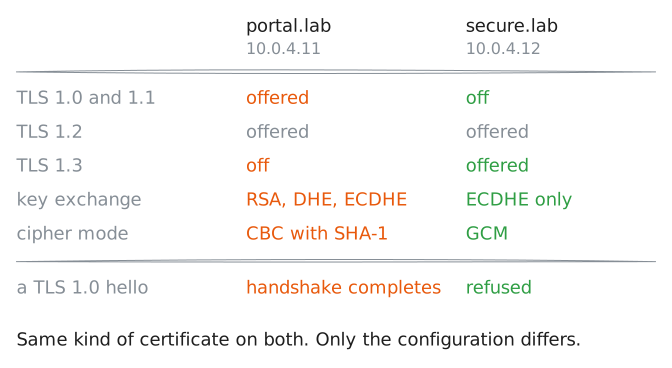
To show Calderbank what "fixed" looks like, Gideon scans the hardened twin on the same network.
secure.labserves the same kind of content with a current configuration. Then he tries the same TLS 1.0 handshake against it.laptop:~# nmap --script ssl-enum-ciphers -p 443 secure.lab laptop:~# openssl s_client -connect secure.lab:443 -tls1 -cipher DEFAULT:@SECLEVEL=0
-
The fix is the config, not the certificate
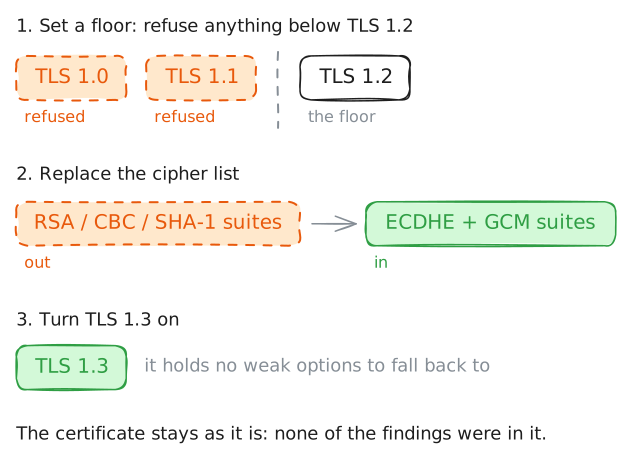
Nothing Gideon found needs a new certificate: the portal's certificate was fine throughout. His report asks for three changes to the server configuration, the difference between the two portals you measured:
- Set a floor. Refuse anything below TLS 1.2 (
ssl_protocols TLSv1.2 TLSv1.3;in nginx,SSLProtocolin Apache, the registry on Windows). This alone removes the TLS 1.0 and 1.1 findings. - Replace the cipher list. Offer only forward-secret, authenticated (AEAD) suites, with
ECDHEkey exchange andGCMor ChaCha20-Poly1305, and drop every CBC-SHA1 suite. The Mozilla SSL Configuration Generator writes this list for you. - Turn TLS 1.3 on. It removes the whole downgrade surface: there are no weak options in it to negotiate.
Then scan again to confirm. The padlock was never the measure. What the server agrees to is, and that is a setting Calderbank controls.
- Set a floor. Refuse anything below TLS 1.2 (