 Hack the Route Start learning Open app
Social engineering
Phishing
A message that impersonates someone a target trusts to make them act — click a link, hand over a login, open a file — before they think.
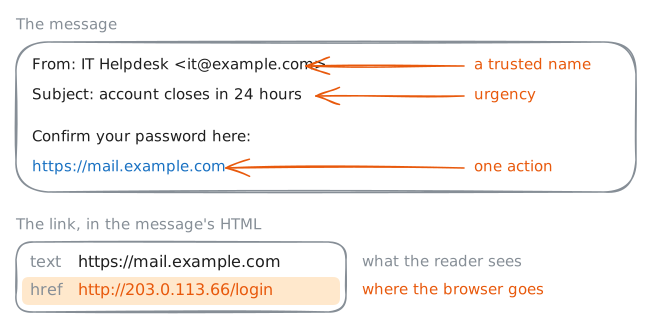
Phishing is a message that impersonates someone the target trusts to make them act: click a link, give a
login, open a file. Its parts: borrowed authority, invented urgency and one call to action. In an HTML
message the link text you see and the href the browser follows are separate, so read the href, never click.
[[email-authentication|SPF, DKIM and DMARC]] stop forgery of your own domain, not a [[lookalike-domain|lookalike]].
Read next
- Pretext The believable story a social-engineering attack wraps around its request so the target acts on it without checking.
- Lookalike domain A domain registered to pass for a real one at a glance — a typo, a swapped letter pair, an extra word or a different ending — used to host phishing, harvesters or misdirected mail.
- Credential harvesting A page that imitates a real login so the credentials a tricked visitor types are captured by the attacker instead of reaching the real service.
- SPF, DKIM and DMARC Three DNS-published policies that let a receiving mail server check that a message really comes from the domain it claims.
- SMTP How mail moves: from a client to its own mail server, then from server to server, found by the domain's MX record.
- Watering-hole attack Compromising a legitimate site a target group already trusts and visits, so the payload reaches the targets through a site they came to on their own.
- Drive-by download A page that pushes a file to a visitor's machine with little or no consent — the delivery step of an attack, separate from whatever the file then tries to do.