 Hack the Route Start learning Open app
The idea
Ana's office has a printer down the hall and a branch office in another city. Time how long each one takes to answer, then cut the line between the offices and see what really stops.
Steps
-
Reach the printer down the hall
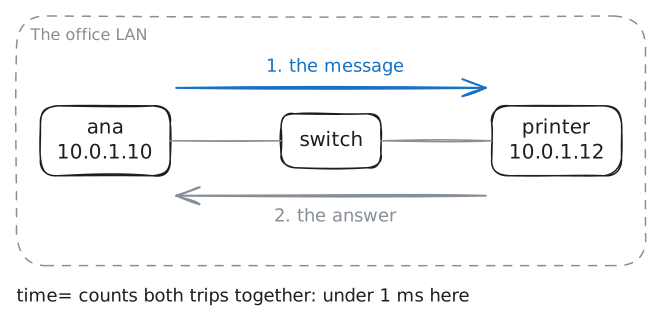
An office can buy one printer for twenty people, as long as every machine can reach it. Sharing like that was an early reason to build networks. Ethernet, the wired network most offices still use, began at Xerox in 1973 by joining office computers to each other and to laser printers.
Ana's machine belongs to the lab, so nothing you run touches your computer. The command
pingsends a small message to a machine and times the answer. Press the arrow to run it.ana:~# ping -c 3 printer
-
Reach the printer over Wi-Fi
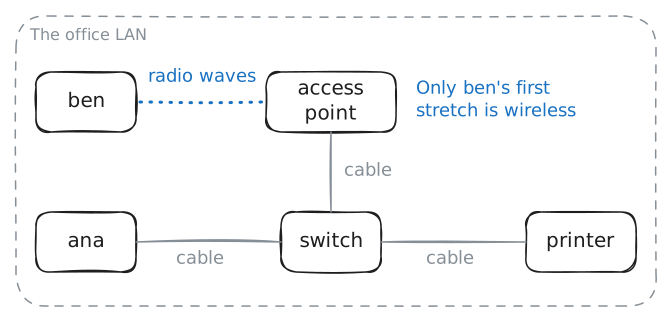
A cable ties a machine to one desk, so offices added radio. Ben's laptop has no cable.
Its Wi-Fi card sends each message as radio waves to an access point, a small box on the wall. That box passes the message into the office network.
Sending through the air is harder than sending down a cable. Machines on one radio channel take turns, so each one may have to wait. Other radios and walls also damage some messages, and Wi-Fi has to send those again.
This lab has no radio, so it adds that delay to Ben's card: about 5 ms for each message and its answer, give or take a few. The lab also loses one of Ben's messages from time to time.
This time you type the command yourself, in the box below. A typing mistake only shows an error, so try again.
ben:~# ping -c 5 printer
-
Reach the branch in another city
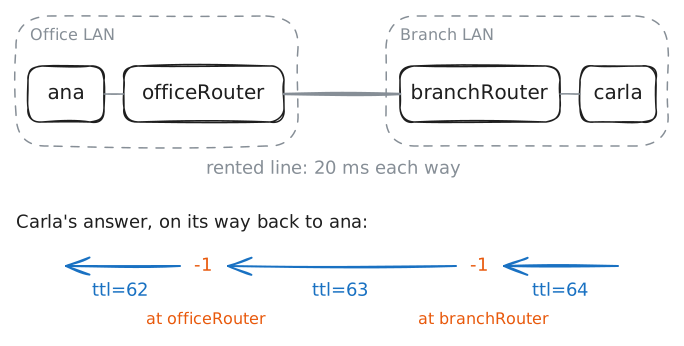
Carla works at the branch, in another city. A company runs its own cables through its own building, and it cannot lay cables under the roads between two cities. So it rents a line from a telephone company.
That is why networks have names by size: size usually decides who owns the cables, what they cost and who fixes them.
At each end of the line sits a router, a machine that joins networks. A switch joins machines into one network, and a router joins one network to another. Ana's message goes to the router in her office, across the line to the router at the branch, and on to Carla's machine.
This lab has no real line, so it holds each message 20 ms in each direction.
ana:~# ping -c 3 carla
-
Cut the line to the branch
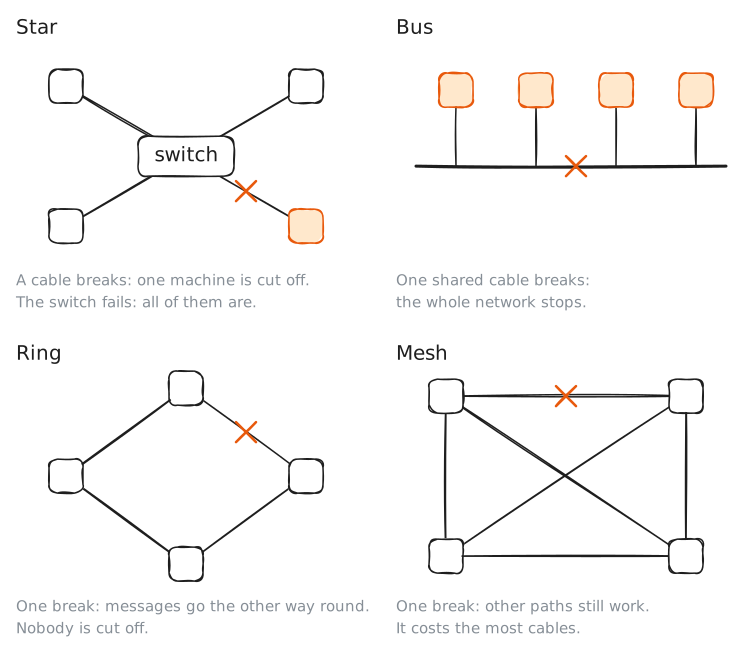
People say "the network is down" as if a company had one network. Ana's company has several, joined by a few links: the office, the branch, and the rented line between them.
Lines like that do fail. Road works cut a cable, or a router loses power.
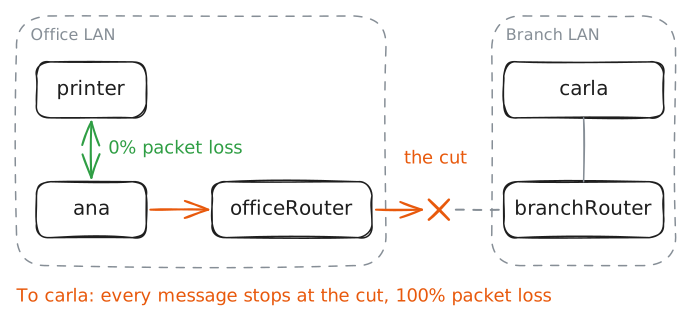
You are about to cut the line between the offices on purpose. The first row makes the cut. Make your guess, then run each row in turn, from the top.
ana:~# ping -c 3 -W 1 carla
ana:~# ping -c 3 printer
-
Find where the path stops
Silence from
carladoes not say where the messages stopped. Any machine on the way could be the fault. So ping each machine on the way, nearest first, and watch for the first one that stays silent.Ana's message passes two machines on its way to Carla.
officeRouteris the router in Ana's office, andbranchRouteris the one at the far end of the line.ana:~# ping -c 3 -W 1 officeRouter ana:~# ping -c 3 -W 1 branchRouter
Run these steps on real machines