 Hack the Route Start learning Open app
The idea
Joelle looks after security at Ferncliff Outdoor, a small gear shop whose domain is ferncliff.lab. A supplier
forwards a payment request that looks like it came from Ferncliff, but the sender's address is a hair wrong. Joelle
now wants to know what else someone has registered to look like Ferncliff. She will list the
lookalike names: resolve a family of near misses, see which are live and which are still open, sort
the tricks apart, and find the ones set up for mail.
Nothing here is attacked. Every step is a DNS lookup, a question to a name server, never a visit. Joelle learns
where each name points without touching any of the hosts. What those hosts would serve belongs to the
phishing-anatomy and credential-harvesters labs. Here the names themselves are the case.
Steps
-
The real domain, and the first lookalike
Start with the real name and one impostor side by side. DNS turns a name into an address.
digasks a name server that question and prints the answer, and+shortprints only the address. Asking the lab's name server directly withdig @10.0.1.53means you read exactly what it holds, with nothing cached in between.Ferncliff's own domain is
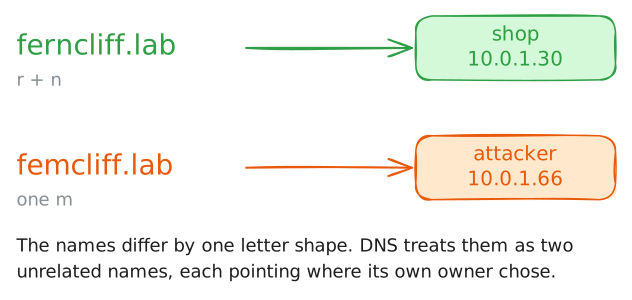
ferncliff.lab. The forwarded message came fromfemcliff.lab. Read it closely: therninfernhas become anm. On screen, in a sans-serif font,rnandmare nearly the same shape, and that is the trick. Resolve both and see where each lands.laptop:~# dig @10.0.1.53 +short ferncliff.lab laptop:~# dig @10.0.1.53 +short femcliff.lab
-
Sort the family: which are live, which are gaps
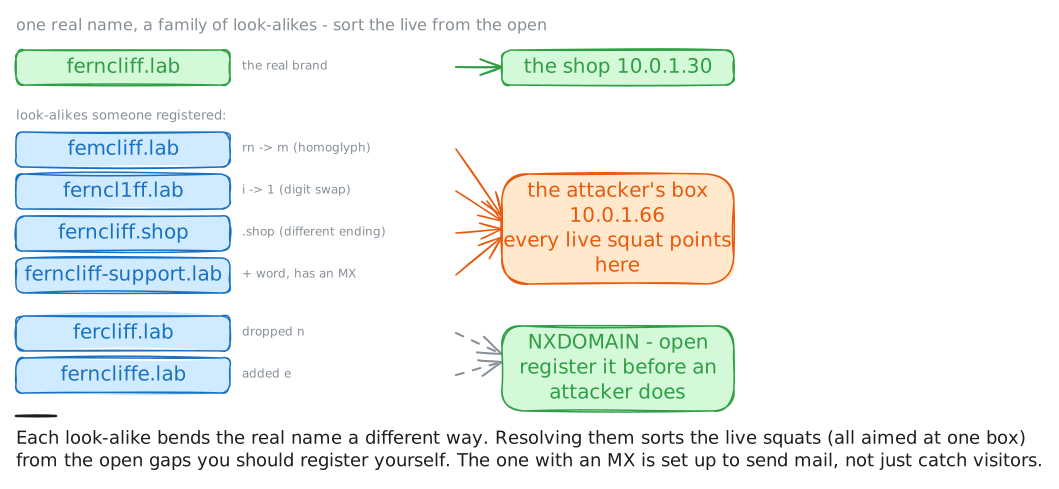
A lookalike rarely comes alone. The same operator usually registers a cluster, and there are only so many ways to bend one name. Work through the obvious candidates and resolve each. This time read the full answer, not only
+short. A registered name comes backstatus: NOERRORwith an address. An unregistered one comes backstatus: NXDOMAIN, "no such name". So one command sorts each candidate into live (someone owns it, and you see where it points) or open (nobody has registered it yet).The families to check: a homoglyph (one letter drawn like another,
rn→m), a digit swap (i→1), a different ending (same name,.shopinstead of.lab), and plain misspellings (a dropped or added letter). Resolve them and sort live from open.laptop:~# dig @10.0.1.53 ferncl1ff.lab laptop:~# dig @10.0.1.53 ferncliff.shop laptop:~# dig @10.0.1.53 fercliff.lab laptop:~# dig @10.0.1.53 ferncliffe.lab
-
Which one is armed to send mail
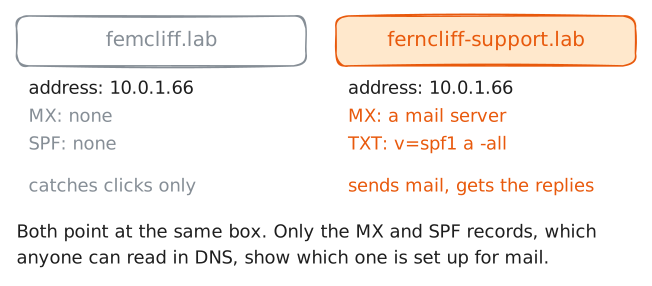
A lookalike that only resolves is a trap someone has to be sent to. A lookalike set up for mail is worse. It can write to suppliers as the brand and get their replies back, which is how invoice fraud and supplier-payment scams work. DNS publishes where a domain's mail goes as its MX record, so you can tell a mail-ready squat from a parked one without sending anything: ask for the MX.
Ask for the MX of two of the live squats. Then read the
TXTrecord of the one with mail. An SPF record (v=spf1 …) is a domain saying which servers may send mail as it. A squat that has published one is not parked: it is set up and expecting to send.laptop:~# dig @10.0.1.53 MX ferncliff-support.lab laptop:~# dig @10.0.1.53 MX femcliff.lab laptop:~# dig @10.0.1.53 TXT ferncliff-support.lab
-
One operator behind all of them
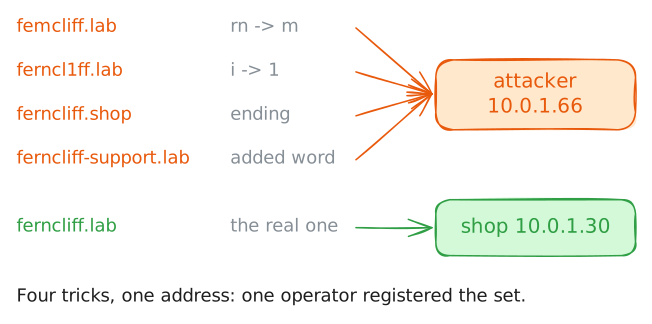
You have four live lookalikes. Are they four separate problems or one? DNS answers that too. Ask for all of them at once (
digtakes several names in one command and prints an answer for each) and read the addresses. When a whole family of squats points at a single machine, you are not looking at scattered opportunists. You are looking at one operator who registered a set and aimed them all at one box.Resolve the four live squats together and compare where they land.
laptop:~# dig @10.0.1.53 +short femcliff.lab ferncl1ff.lab ferncliff.shop ferncliff-support.lab
-
The verdict, and closing the gaps
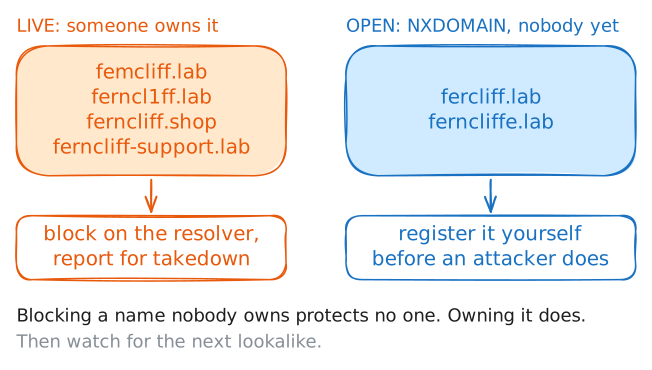
The verdict is a typosquatting campaign: a family of lookalike domains, one of them set up for mail, registered to pass for Ferncliff and all pointed at one attacker box. Writing that down is half the job. The other half is acting on both lists.
For the live squats, block them so a click or a mistype inside Ferncliff goes nowhere: a [[response-policy-zone|response policy zone]] on the company resolver refuses a name for every machine at once (that is the
city-response-policy-zonelab), and you report the set for takedown. For the open ones, theNXDOMAINnear misses, the fix is to register the dangerous ones yourself before an attacker does. A few defensive registrations cost far less than one incident. Then set up monitoring, so the next squat in this family trips an alert the day it is registered.Confirm one of the open gaps is still yours to take.
laptop:~# dig @10.0.1.53 fercliff.lab
Run these steps on real machines