 Hack the Route Start learning Open app
Reconnaissance and exfiltration
Content discovery
Finding the pages and files a web server holds but links to nowhere, by guessing common paths from a wordlist.
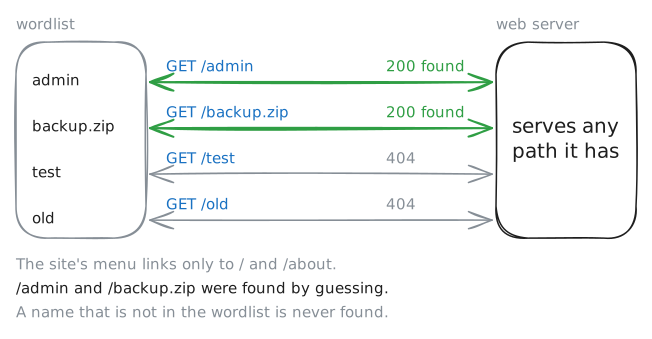
Content discovery is finding pages and files a web server holds but links to nowhere. A server serves any path it
has, so old backups and admin pages stay reachable. A tool (dirb, say) requests each name in a wordlist of
common paths and keeps those that answer; a path not in the list is never found. The defence: remove what should not
be public and turn directory listing off.
Read next
- Port scanning Probing an address's ports to learn which services it exposes, and whether a firewall sits in the way.
- HTTP The web's request and response protocol: plain text over TCP unless wrapped in TLS.
- Web application firewall A reverse proxy in front of a web application that refuses requests matching its rules before they reach it.
- SQL injection Changing what a database query does by sending input that is pasted into the query as code, not data.
- DNS footprinting Reading an organisation's own name server for intelligence — the hosts, mail path and infrastructure it describes — before touching any of them.
- Wordlist profiling Building a wordlist from the target's own words and facts, instead of a generic list, so it contains the base word a real passphrase was coined from.
- Path traversal Reading files outside the intended folder by putting `../` in a filename the server joins onto a path.
- Broken access control An access check that rests on something the client controls, so an attacker simply sets it and walks past.
- CMS enumeration Reading a known content-management system's exact version, users, themes and plugins, to find its weak spot.
- Cross-site scripting Getting a web app to serve your JavaScript to other users, so it runs in their browser as the site itself.