 Hack the Route Start learning Open app
The idea
Juna has an authorised engagement against Fairholme Tickets, and the booking site at 10.0.1.20 looks tiny: a home page, a seat picker, a login. But a web server answers for every path it is configured to, not only the ones a page links to, and the interesting parts are almost always the unlinked ones.
So Juna does not click around. She asks the server for thousands of likely names — admin, backup, old, api — and keeps whatever answers with anything other than "not found". It is called content discovery, and it is how you find the copy of the app someone forgot to delete.
Steps
-
Ask for names the site never gave you
A link is an invitation; it is not the only way in. The server answers any path it is configured for, linked or not, and "unlinked" is not "hidden"; it only means you have to guess the name. So you guess a lot of names, fast, from a list of the ones that pay off most often.
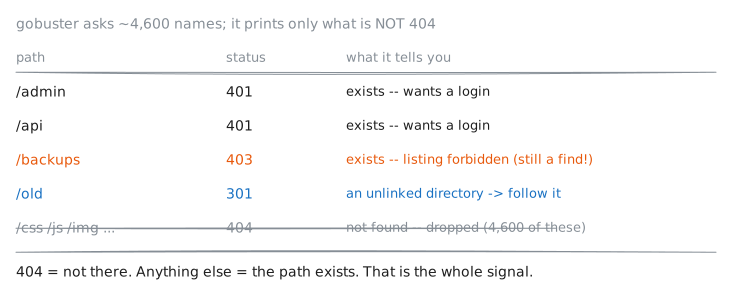
gobuster dirdoes exactly that: it requests every word in a wordlist as a path and prints the ones the server does not answer with404 Not Found. The list here isdirb'scommon.txt, about 4,600 names drawn from real sites. Point it at the server and read what comes back — and read the status code beside each hit, because that is the server telling you what kind of thing it found.kali:~# gobuster dir -u http://10.0.1.20 -w /usr/share/wordlists/dirb/common.txt -q
-
Follow the directory nobody links
/oldanswered301, nginx's way of saying "that is a directory, ask again with a slash". So ask: fetch/old/and read what the server hands back. A directory with noindexpage might list its files; one with anindex.html, like most, serves that instead — and an index page written for developers often explains exactly what the directory is.This is the moment content discovery pays off. A name in a wordlist got you to a directory the site never mentions; now you read it like any page and let it tell you what it is.
kali:~# curl -s http://10.0.1.20/old/
-
The copy nobody turned off
The old index named
/old/customers. The current API guards customer data behind the401you saw; this deprecated copy was written before that guard existed. Ask it for the customer list the same way you would ask the real API — a plainGET— and see whether anything checks who you are.kali:~# curl -s http://10.0.1.20/old/customers
-
Hunt files, not just folders
Directories are half of it. The other half is loose files — a config saved with a
.bakextension, a database dump, an editor's swap file — dropped at the web root by a careless deploy and linked by nothing.A wordlist of bare names misses them, because the name is
exportbut the file isexport.sql. So you sweep extensions: for every word in the list, also tryword.sql,word.bak,word.zip.ffufis built for this.-u http://10.0.1.20/FUZZputs each word whereFUZZis,-e .sqladds the extension to every try, and-mc 200keeps only the ones that actually answer200 OK.kali:~# ffuf -w /usr/share/wordlists/dirb/common.txt -u http://10.0.1.20/FUZZ -e .sql -mc 200 -s kali:~# curl -s http://10.0.1.20/export.sql
-
Swap seats: the noise it made
Now you run Fairholme's server. Two things have to happen: close the holes, and ask whether you could even have seen Juna doing this.
The holes close by deletion — the deprecated
/oldAPI off the server, theexport.sqldump off the web root — because both are surface that should not exist, not settings to tune. Then read the access log. Unlike plain recon, content discovery is loud: every miss is a404, and 4,600 of them in a few seconds is a signature nothing legitimate produces.web:~# rm -rf /srv/www/old web:~# rm -f /srv/www/export.sql kali:~# curl -s http://10.0.1.20/old/customers web:~# grep -c " 404 " /var/log/nginx/access.log
Run these steps on real machines