 Hack the Route Start learning Open app
The idea
Beatrix has an authorised engagement against Glenmara Archive, a public records site that serves scanned documents. You request a document by its file name and the archive hands back its contents — exactly what it is for.
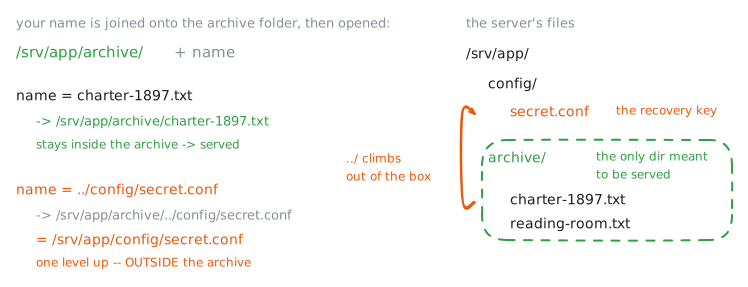
The question a tester asks is: what counts as a file name? If the archive takes your name and opens it without checking that it stays inside the archive folder, then a name is not only charter-1897.txt — it can be ../ something, or an absolute path, and the same endpoint will read a file the archive was never meant to serve. That is path traversal, and it turns "download a document" into "read any file the server process can".
Steps
-
The archive opens files by name
You are on Beatrix's box,
kali, with the archive at10.0.1.20. Open it in the Viewer to see the reading room, then use the API the way it is meant to be used: list the documents, and fetch one by name. The point of this step is to prove the shape of the endpoint — you give it a name, it opens that file and returns the bytes.kali:~# curl -s http://10.0.1.20/api/documents kali:~# curl -s -G --data-urlencode "name=charter-1897.txt" http://10.0.1.20/api/document
-
Climb out of the archive
Test whether the name is contained. A
../segment means "parent directory"; enough of them walk from the archive folder up to the file system root, and from there you can name any absolute path. Ask for/etc/passwdby climbing out — the classic proof a reader is not contained.kali:~# curl -s -G --data-urlencode "name=../../../../etc/passwd" http://10.0.1.20/api/document
-
Reach the app's own secret
/etc/passwdproves the hole; now use it on something that matters. Applications keep their configuration beside the code, not in the public folder — the archive's accession notes even mention the configuration is "kept separately from this archive". From the archive folder, the app's directory is one level up, and a recovery config sits inconfig/there. Climb out only far enough to read it.kali:~# curl -s -G --data-urlencode "name=../config/secret.conf" http://10.0.1.20/api/document
-
Swap seats: contain the path
Now you run Glenmara. The wrong fix is to search the name for
..and reject it — attackers have encodings (%2e%2e,....//), absolute paths and symlinks that slip past string filters. The right fix is to resolve the final path and require it to stay inside the archive. The correct endpoint,/api/file, does exactly that. Send it the same traversal and watch it refused.kali:~# curl -s -o /dev/null -w "%{http_code}" -G --data-urlencode "name=../config/secret.conf" http://10.0.1.20/api/file kali:~# curl -s -G --data-urlencode "name=reading-room.txt" http://10.0.1.20/api/file
Run these steps on real machines